Category: Mom’s Occasional Money Advice

  • Money+Literature: “Do You Ever Think What Money Is?”

    Money+Literature: “Do You Ever Think What Money Is?”

    The Mom Weekly Volume 154: July 21, 2026

    You can read this, or any other previous Mom Weeklies, by going to the home page here.

    Notes:

    I realized kind of late that I didn’t have something queued up for this week. And then I realized that I have a LOT of writing in various places.

    A couple of years ago, for instance, I had written a few posts about money and literature, with the intention of making them into a Substack. That Substack didn’t happen, but I did start a Substack on points and miles, and please subscribe to it if you have not yet done so.

    When I remembered them, I found the one I’m sharing today. I know it is really long, but it is very worthwhile!

    Anthony Trollope is a very prolific 19th century author, and sometimes he does write too long, but he had good things to say! I hope you will indulge both the lengthy quote and my thoughts on it.

    Remember how much I love you (and 19th century English literature),

    Mom

    Money+Literature: “Do You Ever Think What Money Is?” (From the —recent— Vault)

    The Duke of Omniun schools his son, and us, on how to be worthy in obtaining and spending money.

    Gerald told his story, standing bolt upright, and looking his father full in the face as he told it. “You lost three thousand four hundred pounds at one sitting to Lord Percival—at cards!”

    …..

    How old are you?”

    “I am just twenty-one.”

    “You are beginning the world well, Gerald! What is the engagement which Silverbridge has made with Lord Percival?”

    “To pay him the money at the end of next month.”

    “What had Silverbridge to do with it?”

    “Nothing, sir. I wrote to Silverbridge because I didn’t know what to do. I knew he would stand to me.”

    “Who is to stand to either of you if you go on thus I do not know.”

    To this Gerald of course made no reply, but an idea came across his mind that he knew who would stand both to himself and his brother.

    “How did Silverbridge mean to get the money?”

    “He said he would ask you. But I thought that I ought to tell you.”

    “Is that all?”

    “All what, sir?”

    “Are there other debts?” To this Gerald made no reply. “Other gambling debts.”

    “No, sir;—not a shilling of that kind. I have never played before.”

    “Does it ever occur to you that going on at that rate you may very soon lose all the fortune that will ever come to you? You were not yet of age and you lost three thousand four hundred pounds at cards to a man whom you probably knew to be a professed gambler!” 

    The Duke seemed to wait for a reply, but poor Gerald had not a word to say.

    “Can you explain to me what benefit you proposed to yourself when you played for such stakes as that?”

    “I hoped to win back what I had lost.”

    Facilis descensus Averni!” said the Duke, shaking his head. “Noctes atque dies patet atri janua Ditis.”

    No doubt, he thought, that as his son was at Oxford, admonitions in Latin would serve him better than in his native tongue. But Gerald, when he heard the grand hexameter rolled out in his father’s grandest tone, entertained a comfortable feeling that the worst of the interview was over. 

    “Win back what you had lost! Do you think that that is the common fortune of young gamblers when they fall among those who are more experienced than themselves?”

    “One goes on, sir, without reflecting.”

    “Go on without reflecting! Yes; and where to? where to? Oh Gerald, where to? Whither will such progress without reflection take you?”

    “He means—to the devil,” the lad said inwardly to himself, without moving his lips.

    “There is but one goal for such going on as that. I can pay three thousand four hundred pounds for you certainly. I think it hard that I should have to do so; but I can do it,—and I will do it.”

    “Thank you, sir,” murmured Gerald.

    “But how can I wash your young mind clean from the foul stain which has already defiled it? Why did you sit down to play? Was it to win the money which these men had in their pockets?”

    “Not particularly.”

    “It cannot be that a rational being should consent to risk the money he has himself,—to risk even the money which he has not himself,—without a desire to win that which as yet belongs to his opponents. You desired to win.”

    “I suppose I did hope to win.”

    “And why? Why did you want to extract their property from their pockets, and to put it into your own? That the footpad on the road should have such desire when, with his pistol, he stops the traveller on his journey we all understand. And we know what we think of the footpad,—and what we do to him. He is a poor creature, who from his youth upwards has had no good thing done for him, uneducated, an outcast, whom we should pity more than we despise him. We take him as a pest which we cannot endure, and lock him up where he can harm us no more. On my word, Gerald, I think that the so-called gentleman who sits down with the deliberate intention of extracting money from the pockets of his antagonists, who lays out for himself that way of repairing the shortcomings of fortune, who looks to that resource as an aid to his means,—is worse, much worse, than the public robber!

    He is meaner, more cowardly, and has I think in his bosom less of the feelings of an honest man. And he probably has been educated,—as you have been. He calls himself a gentleman. He should know black from white. It is considered terrible to cheat at cards.”

    “There was nothing of that, sir.”

    “The man who plays and cheats has fallen low indeed.”

    “I understand that, sir.”

    ”“He who plays that he may make an income, but does not cheat, has fallen nearly as low. Do you ever think what money is?”

    The Duke paused so long, collecting his own thoughts and thinking of his own words, that Gerald found himself obliged to answer.

    “Cheques, and sovereigns, and bank-notes,” he replied with much hesitation.

    “Money is the reward of labour,” said the Duke, “or rather, in the shape it reaches you, it is your representation of that reward. You may earn it yourself, or, as is, I am afraid, more likely to be the case with you, you may possess it honestly as prepared for you by the labour of others who have stored it up for you. But it is a commodity of which you are bound to see that the source is not only clean but noble.

    …..

    “There is nothing so comfortable as money,—but nothing so defiling if it be come by unworthily; nothing so comfortable, but nothing so noxious if the mind be allowed to dwell upon it constantly. If a man have enough, let him spend it freely. If he wants it, let him earn it honestly. Let him do something for it, so that the man who pays it to him may get its value. But to think that it may be got by gambling, to hope to live after that fashion, to sit down with your fingers almost in your neighbour’s pockets, with your eye on his purse, trusting that you may know better than he some studied calculations as to the pips concealed in your hands, praying to the only god you worship that some special card may be vouchsafed to you,—that I say is to have left far, far behind you, all nobility, all gentleness, all manhood!

    Write me down Lord Percival’s address and I will send him the money.”

    Then the Duke wrote a cheque for the money claimed and sent it with a note, as follows:—

    The Duke of Omnium presents his compliments to Lord Percival. The Duke has been informed by Lord Gerald Palliser that Lord Percival has won at cards from him the sum of three thousand four hundred pounds. The Duke now encloses a cheque for that amount, and requests that the document which Lord Percival holds from Lord Silverbridge as security for the amount, may be returned to Lord Gerald.

    Let the noble gambler have his prey. He was little solicitous about that. If he could only so operate on the mind of this son,—so operate on the minds of both his sons, as to make them see the foolishness of folly, the ugliness of what is mean, the squalor and dirt of ignoble pursuits, then he could easily pardon past faults. If it were half his wealth, what would it signify if he could teach his children to accept those lessons without which no man can live as a gentleman, let his rank be the highest known, let his wealth be as the sands, his fashion unrivalled?

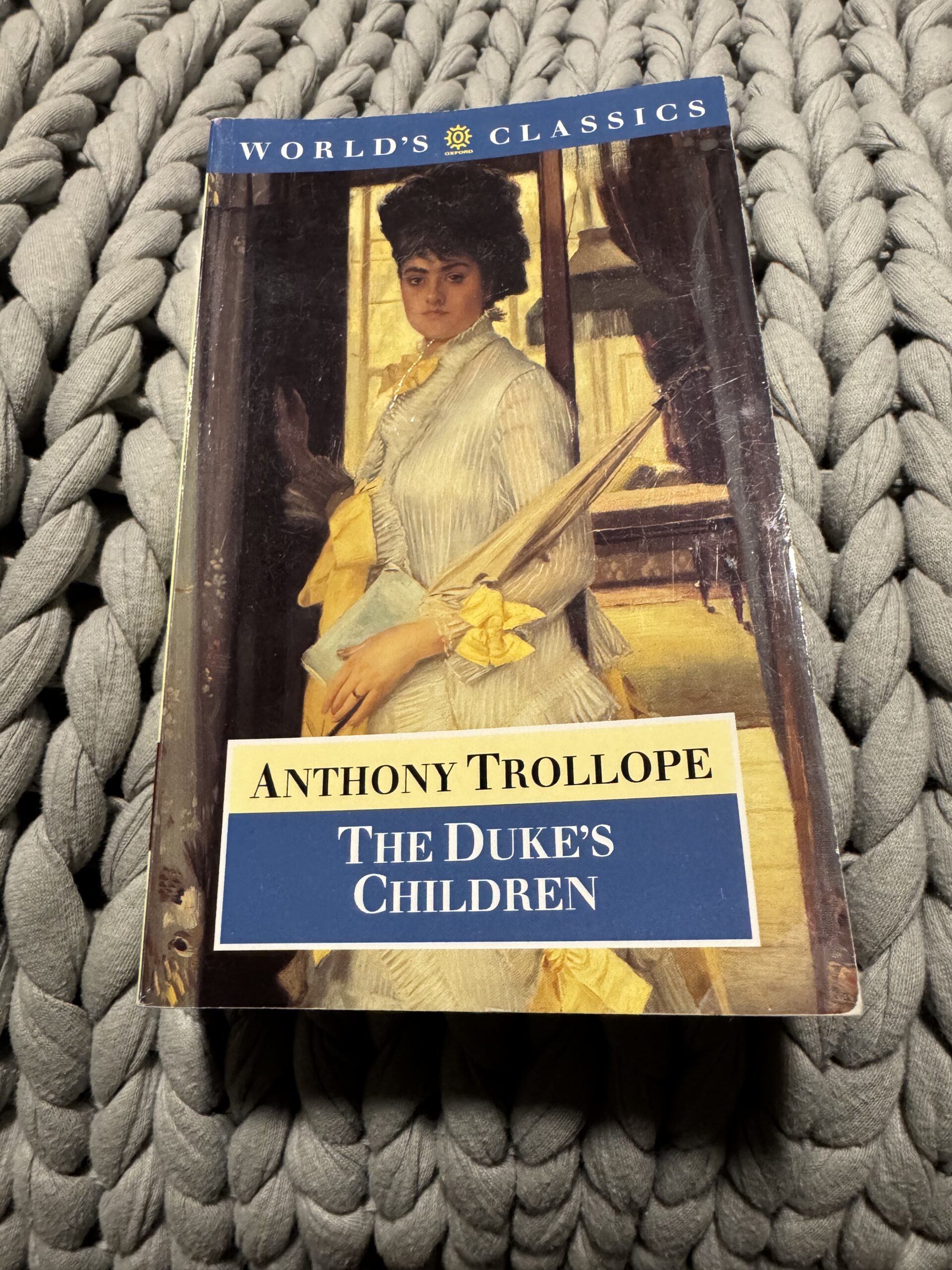
    —Anthony Trollope, The Duke’s Children, Chapter 65

    If I could get away with reproducing entire chapters of some of the great novels, I promise you I would do it. In a heartbeat. There is so much context and information in the entire chapters, of entire novels, that give us good advice centuries after they were written.

    But long as today’s passage is, it is only a part of this chapter of Anthony Trollope’s 1879 novel The Duke’s Children.

    The Duke’s Children is the final novel in the six-book Palliser series, following the Palliser family and friends through many decades. All of the Palliser novels are worth reading and enjoying! The audio versions are delightful.

    Satisfying as it would be to me, I’m not going to spend time explaining or expounding on 18th and 19th century entail, or inheritance law, or how the monetary system worked (a particular area of concern for the Duke when he was Chancellor of the Exchequer in a prior Palliser novel).

    What I most want to convey to you, dear reader, in is how the chosen passages reach through the centuries and give us solid money (and often life) advice.

    So here’s some context on this quote:

    The Duke of Omnium is a widower, shepherding his three children into young adulthood. Th elder son, “Silverbridge,” has in the past had his own money troubles, and he’s helped out his younger brother, Gerald, by pledging to pay a debt Gerald made by gambling foolishly.

    But when he goes home, Gerald decides to do the manly thing and tell his father straight out about the debt. This long exchange is only part of this wonderful chapter! I encourage you to look it up to see how Gerald reports on this conversation in a letter to Silverbridge.

    Some context/translation:

    Facilis descensus Averni!  Noctes atque dies patet atri janua Ditis.

    = “The descent to hell is easy. The gates of hell are open night and day.”

    This is a quote from Virgil’s Aeneid.

    Money Takeaway

    The Duke tells Gerald, and us: 

    “There is nothing so comfortable as money,—but nothing so defiling if it be come by unworthily; nothing so comfortable, but nothing so noxious if the mind be allowed to dwell upon it constantly. If a man have enough, let him spend it freely. If he wants it, let him earn it honestly. Let him do something for it, so that the man who pays it to him may get its value.”

    It’s pretty self-explanatory. 

    —Money can and should make us comfortable, but it’s more of a burden if we come by it “unworthily” such as in gambling. 

    —Dwelling too much on money is bad for your mind and your soul.

    —If you have money to spend, spend it. If you don’t, earn it honestly.

    —Gambling is an ignoble way to come by money, only a few steps better than being a “footpad” (someone who mugs people on foot).

    Questions for Reflection

    —Do you think about money too much, or not enough?

    —“There is nothing so comfortable as money.” True or not in your life?

    —Do you agree with the duke’s assessment that gambling is bad?

  • I am asking you once again to update your net worth (Mom’s Occasional Money Advice)

    I am asking you once again to update your net worth (Mom’s Occasional Money Advice)

    The Mom Weekly Volume 151: June 30, 2026 

    You can read this, or any other previous Mom Weeklies, by going to the home page here.

    I am Asking You Once Again to Update Your Net Worth (Mom’s Occasional Money Advice)

    We are at the end of the quarter, so it is time to update your net worth!

    Yes, this headline (and this post) pops up every quarter, and that is not going to change. 

    Here’s why: I am trying to convince you to start this practice early, so you can feel more confident over time about how your money life looks. It truly works.

    Calculating net worth has been enormously helpful in making me feel more confident about our finances, just by knowing.

    Before doing this regularly, I might have been concerned about our spending at different times—for instance, sometimes we would have a year when we had big tuition bills, or we had done a lot of house-related spending. 

    I would have an amorphous feeling like, “eek, we are spending too much..” or “things don’t feel stable, but I can’t imagine how to figure this out except for taking a million years to track every bit of our spending…” 

    Or, alternatively, I might think, “Everything’s great!” But not really know. 

    Knowledge is power, as the kids like to say. And it’s true!

    Even when headlines talk about how bad the stock market is doing, or how terrible the housing market is in our area—both things that occurred in the recent past—I can look at how our personal finances are doing, and not pay attention so much to what the headlines say.

    Here is a version of my regular pitch:

    This may take slightly longer this first time, if you have not done so. But I promise you, over time, you will be happy that you do this. 

    The only reason I hesitate is that, especially for younger people, it could be pretty likely you have a negative net worth, largely because of student loans. But that’s will be so temporary (over the long haul!) that you should not be discouraged by it. 

    When people begin to track their net worth, they call it “getting back to zero” when they have a zero net worth. That may not seem promising, but it’s a great accomplishment for those who have paid off a significant amount of debt, whether student loan debt, credit card debt, or other types of debt. 

    And it can be very encouraging to see an improvement in your net worth over time. 

    Here is a super-simple net worth calculator spreadsheet I put together.  I’ve updated it with newer dates.

    There’s no formatting with cool colors and such, but it works and completes the calculations for you. Let me know what you think about it!

    A few notes:

    *Make your own spreadsheet or list. Unfortunately, Google Sheets does not allow password-protecting of items. I prefer to keep this information, and most of my spreadsheets, in a format I can password protect. Think Microsoft Excel, Apple’s Numbers, etc. You can even do this on paper if you want, and store it somewhere safe. 

    *There are two “sheets” in the shared spreadsheet — the first is a blank one, and the second is a sample with random numbers that I have included. I have added made-up numbers to the sample sheet, so you can see how the numbers change over time.

    *Sometimes people do not include their vehicles or mortgages. I do, because you can see how much equity you have in the house or vehicle. But I mentally don’t include them with the same weight as other assets, since they are not liquid and it’s not likely one would sell them for living expenses, in retirement or not.

    Action Item: Read the Declaration of Independence (out loud)

    I first learned about this years ago—I heard about a family that hosted a big 4th of July picnic each year (as my parents used to do!) and have the Declaration of Independence read aloud sometime during it. The link is to the National Archives transcription of the Declaration. If I remember correctly, the older kids would be the ones tasked with reading it.

    I think I discovered this when you kids were very little, and I thought, oh, that would be fun to do once you are older! And then I never did.

    Anyway, I do think it would be worthwhile. It wouldn’t take “forever” to read aloud, and people could take turns. Consider it!

  • Sell Your Books (Mom’s Occasional Money Advice)

    Sell Your Books (Mom’s Occasional Money Advice)

    The Mom Weekly Volume 148: June 9, 2026 

    Notes: 

    I haven’t done a “Mom’s Occasional Money Advice” in awhile. I was talking with some friends recently (once at book group, once at church), and people were unaware of Sell Your Books and similar services. And people were really interested in how it works, and how easy it is.

    I think it is such a good idea—not just for making a few dollars, but for keeping books out of the landfill and in circulation! Win/win. So I decided to turn it into a Weekly.

    Remember how much I love you,

    Mom

    Sell Your Books (Mom’s Occasional Money Advice)

    I’ve been surprised in recent months how few people know about this: selling your unused or extra books easily and with little friction.

    Of course we still love books at our house, and the number of books to people in our house is off the charts. That won’t be changing any time soon. But you can’t keep every book forever, nor should you. 

    Bringing them to Goodwill or a library book sale can seem pointless, because you wonder how many of the books will just be recycled. And yet trying to sell normal books that aren’t worth tons of money is time consuming. Enter: Sell Your Books. 

    Here’s how it works: you scan the bar code on the back of any book, and the app tells you if they will buy it, and for how much. Sometimes it’s 18 cents, and sometimes it’s $18. Usually it is somewhere between. Occasionally the app says, “Sorry, we have enough of this one.”

    Once you hit a certain threshold (I think it’s $8), you box up your books, use a prepaid label (you don’t have to pay for shipping) emailed by the app, and bring it to FedEx. In a few weeks, you’ll have a check or PayPal deposit.

    It’s not life-changing money, but that’s not the point. In our throwaway culture, I’m happy to be getting books out of my inventory and to a place with millions of books. That way, when someone wants my old copy of a book, World of Books has it in stock for that person to buy affordably.

    Next time you are decluttering books, consider using an app like Sell Your Books to make letting books go easier.

    Interesting/Notable: 

    How to walk into a car dealership with the upper hand—Ask, Save, Earn

    I found this a really helpful read as we continue our process of car buying!

    Obituary of the inventor of Candyland (NY Times gift article)

    I don’t really like CandyLand, nor have I ever, but I enjoy that the Times does these obituaries of people (often women!) who had been forgotten or not lauded when they died.

    Action Item: Celebrate Flag Day

    Flag Day is this Sunday, and it’s worth considering how you might want to mark this holiday, since this July we celebrate the 250th anniversary of the Declaration of Independence.

    This is a surprisingly thorough article about the origins of Flag Day, for some context.

    As I have said before many times, Grandpa was a big fan of Flag Day. I’m not really sure why, but it is kind of a quiet favorite for me every year because of that. I will try to display a flag this year, as I have been bad about it in recent years. I might even try to make a flag-inspired treat! Here are some ideas if you would like to, as well.

  • Just Call Me Mrs. Malaprop

    Just Call Me Mrs. Malaprop

    The Mom Weekly Volume 140: April 14, 2026 

    You can read this, or any other previous Mom Weeklies, by going to the home page here. https://themomweekly.com/

    Notes: 

    I hope you will indulge me talking about mispronunciations and mis-sayings yet again. There’s always more to say about it!

    Also, taxes are due tomorrow, so note the “action item” below.

    Remember how much I love you,

    Mom

    Just Call Me Mrs. Malaprop

    The title of this weekly comes from Richard Sheridan’s 1775 play, The Rivals. Mrs. Malaprop is a main character, who keeps using the wrong word for things, to humorous effect.

    The term “malapropism” was coined from the character’s name, because she kept using the wrong words, often to hilarious effect. (“Fy, fy, Sir Anthony! you surely speak laconically.” …. “she’s as headstrong as an allegory on the banks of Nile.”)

    In the days after last week’s TMW sent, I had so many occasions to remember other issues with pronunciations and getting words wrong.

    First—

    I was listening to two financial planners talking about credit card rewards, not very intelligently, I might add. It annoys me when people talk with assurance about something they really don’t know that much about. Someone had shared it on LinkedIn, and it was playing as I drove around; otherwise, I would have turned it off.

    Anyway, one of the planners kept saying, “I think that AIM-EX points are not as valuable as…” “AIM-Ex is one of the big rewards programs.” I couldn’t believe my ears. It’s American Express. So the shortened version is AmEx, and it’s pronounced Am-Eks, just as you would expect. Oy vey.

    And then—

    I realized: I cannot cast the first pronunciation stone. 

    I, too, have many of my own blind spots when it comes to pronouncing things. Apart from the wonderful “debacle” debacle from the 1980s, I now know how to pronounce the word. But there are others I still can’t get quite right.

    For instance, even now, I have to think carefully before I pronounce the words “biopic” or “eco-friendly.” That’s because, much to the amusement of several of you kids, I can’t seem to get it right! I have to remember that it’s a “biography picture” instead of “biopic” pronounced like “bionic.” And eco-friendly—I’m honestly still not sure. I ask people how to pronounce it.

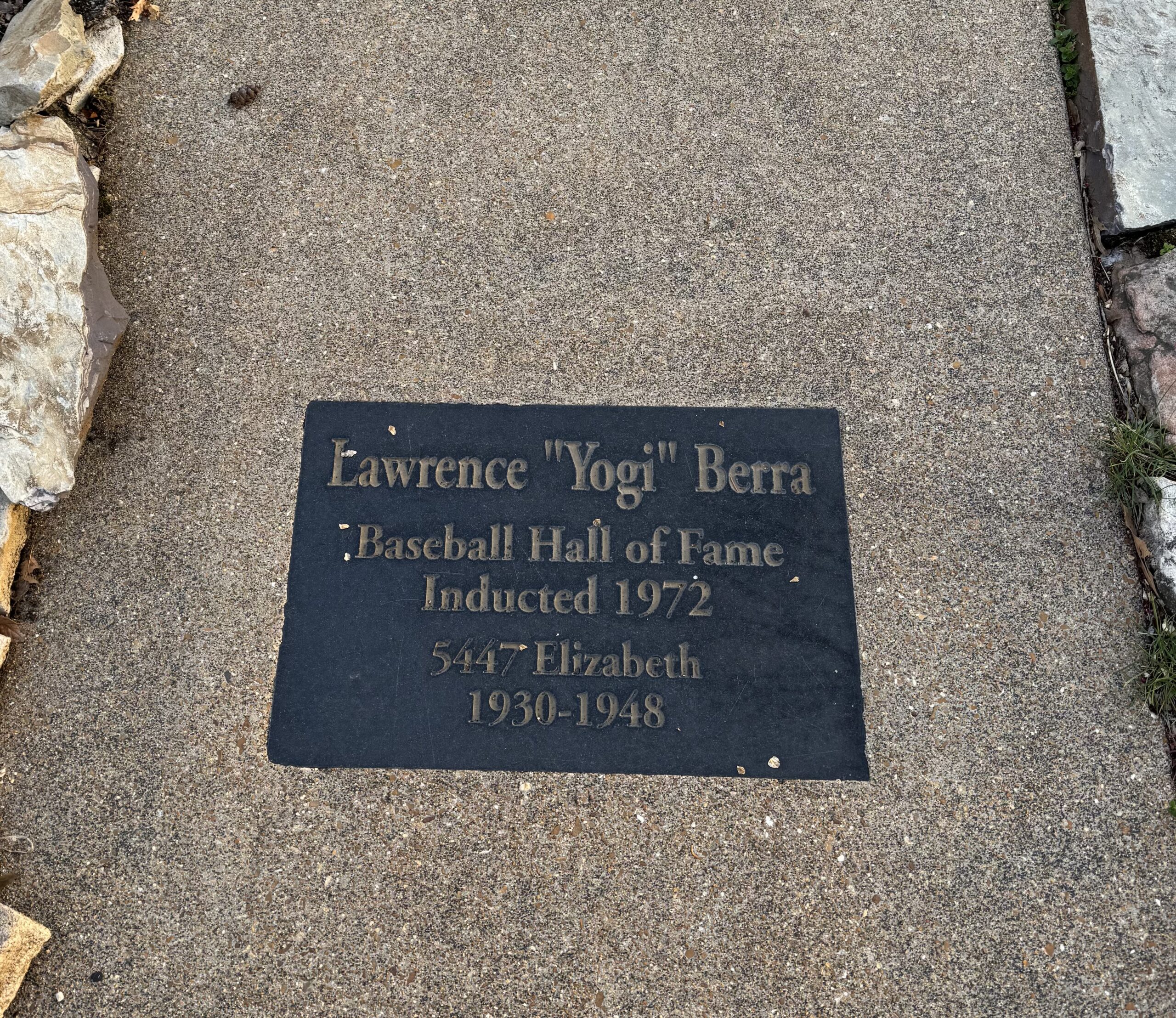
    I do think it is a good idea to both sound intelligent and be intelligent, but I also remember the beloved Yogi Berra, the beloved and baseball Hall-of-Famer. [And I just found out that there is a Yogi Berra Museum and Education Center near to Dad’s alma mater.

    Yogi Berra, the son of Italian immigrants, grew up on The Hill in St. Louis. I often walk by his boyhood home, and this is in the sidewalk.

    He’s known for so many great one-liners, from “It’s deja vu all over again.” To “When you come to a fork in the road, take it.”

    Yogi Berra was loved not despite his “yogi-isms” but because of them. May that be said of all of us.

    Interesting/Notable:

    An interview with Martin Kochanski, founder of Universalis.

    This is not a new interview, but everyone knows my love of the Universalis app!

    Adam Smith and the Wealth of Nations (Wash Post gift article)

    Quote: 

    The book is not, as sometimes believed, a hymn to greed, a paean to market fundamentalism and red-in-tooth-and-claw capitalism. It was an attempt to understand how a commercial society could generate prosperity without collapsing into corruption.

    An Action Item: Are Your Taxes Finished Yet?

    Fortunately, I did complete our taxes in the last week. I hope you have too! If not, consider this your gentle nudge to just get it completed!

    Also, I realized I neglected to encourage you to update your net worth as I do each quarter. The first quarter ended March 31, so it’s not too late to also do that! If you need them again, here are the instructions and the reasoning behind doing this.

  • Set Up Alerts for All Your Credit Cards (Mom’s Occasional Money Advice)

    Set Up Alerts for All Your Credit Cards (Mom’s Occasional Money Advice)

    The Mom Weekly Volume 130: February 3, 2025

    You can read this, or any other previous Mom Weeklies, by going to the home page here.

    Notes:

    I decided to pre-empt what I had scheduled this week to share about a useful financial housekeeping activity. This one is topical because it happened to be just a few days ago.

    I promise you that you will feel good once you complete this!

    It’s especially good to do these kinds of activities during some of the extra-cold days we’ve had recently when it’s hard to get outside. 

    Remember how much I love you,

    Mom

    Set Up Alerts for All Your Credit Cards (Mom’s Occasional Money Advice)

    Just a few days ago, I was checking the Chase app on a newer credit card to see how close I was to the spending I would need to trigger the sign-up bonus. The sign-up bonus for this particular card is a lot of points, so it was definitely worth checking!

    I noticed several small charges from the same merchant, and several from another, and I thought, wait, did I spend money at something called “M Solutions”?

    This can be tricky because sometimes charges will occur that appear odd. We have lunch at the excellent Skylight Commons cafe at the Mayo Clinic on the days we are there—but the merchant name is something strange that I know now, but might have thought was sketchy the first time or two I saw the charge.

    Anyway, I was heading out for my dentist appointment at that time, so I couldn’t do much until I got home. When I got home, I checked on all the charges, and saw a dozen or so charges, ranging from 99 cents to $27, from four merchants I did not recognize. 

    The fraud department representative that I spoke to was very nice, and I went over all the charges with her. She could see they were all connected to the same digital wallet (not mine, obviously), and so she cancelled the card and I’ll get a new one in a few days.

    I realize that I had not set up text or app alerts for this particular card, because it is relatively new. So I took some time that afternoon to check all of our credit cards and make sure that text/app alerts are enabled. Now, anytime there is a charge on any of our cards, I (or Dad) will get a text message or app alert, or both. 

    I do have this set up for many cards, so that I can appear to be a mind reader. I told Dad when I was setting all the alerts up that I already get those. I said, “Didn’t you make a purchase using (certain credit card) at Trader Joe’s about an hour ago?” Dad thought that my knowledge of his wherabouts a state away was pretty impressive, and I agree. 🙂

    The typical way to do this is on the app or website of your card’s bank, look into “profile & settings.” Usually within there or something similar, there is a “manage alerts” section. Just be sure that you save after you change the alerts. I’m sharing a screen from within Chase so you can see what I mean. Be sure to check all of the categories of alerts, especially any purchases!

    For some reason, it was hit or miss with our cards. Some had alerts of all kinds enabled, and some had few or none. It was a good feeling to be able to get all the cards set up that way. You’ll be glad, too, once you complete this task!

    Interesting/Notable: 

    Seeking Beauty — EWTN Studios.

    Erica Campbell, the founder and owner of Be a Heart, a Catholic goods shop, shared this show in a recent email (her emails are great, by the way. I find her very sensible and spiritually mature). 

    I’ve only watched part of the first episode, but it’s got great production value and it’s highly watchable! I was not aware of the actor/producer who narrates it, but he does look familiar. You younger people may recognize him more. 🙂

    They Wanted Another Bathroom. So They Built a $1.3 Million Home: WSJ

    I read this article because of the headline, but it’s actually about a general contractor and architect with a very interesting personal history that led to him becoming a home builder. Worth a read!

  • Believe What You Read, Teach What You Believe; Live What You Teach

    Believe What You Read, Teach What You Believe; Live What You Teach

    The Mom Weekly Volume 125: December 30, 2025

    You can read this, or any other previous Mom Weeklies, by going to the home page here.

    Notes:

    One of my children—who shall remain nameless—mentioned that I read more books in 2025 than she has, which surprised me since she is quite well-read, and that is a big part of her career! There are two factors that contribute to this. One factor is hers: she does not “count” books that she reads for classes. One is mine: I include books that I do not finish.

    I disagree with her that not counting books just because they are used in class is counter-productive, not the least of which counting them increases your total number! Also, I do like knowing books that I have read or read part of, so I can look back later if something sounds familiar to me. That happened when I saw that The Other Bennet Sister, a recent novel about Mary Bennet, the “dowdy” sister in Pride & Prejudice, is being made into a television show. (

    I could look up and see that I had read The Other Bennet Sister in 2022.

    Perhaps the more controversial question is, can I count books that I do not finish as among my books read for any particular year? I say a firm “yes” under the following conditions: not just that I read the first page and immediately send it back to the library. I give a book a good shot, read several chapters and perhaps more, and then for whatever reason realize it’s not worth my while to finish it. 

    I consider that a book “read,” but imagine that others would have a different opinion! If I don’t count those, my total number of books would go down by a decent percentage. The other type of book I count is picture books or children’s books, and people may take exception with that (But on this, they are wrong.)

    What do you think? No matter what, I hope that you are reading books!

    Remember how much I love you,

    Mom

    Believe What You Read, Teach What You Believe; Live What You Teach

    A few weeks ago, Dad & I attended the Mass for the ordination to the diaconate to someone we’ve known since he was a baby. That was quite an experience! He will be ordained a priest in May, but this liturgy was very very moving, 

    There was one other young man being ordained, and so they repeated several of the vows and parts of the actual ordination portion of the Mass. One part was the “Presentation of the Book of the Gospels.” This took place just after the Litany of the Saints and the actual ordination. The young men each approached the Bishop, who gave each a “Book of the Gospels.” We were seated in the back, so I’m not sure exactly what that it, but I imagined it to be one of the big lectionaries that are held up before the Gospel reading at Mass. And what the Bishop said, and repeated twice, struck me so much that I brought out my phone to write it down. Here it is:

    “Receive the Gospel of Christ, whose herald you have become. Believe what you read, teach what you believe, and live what you teach.”

    Believe what you read. Teach what you believe. Live what you teach. 

    Isn’t that a good maxim to ponder in the new year? I almost want to make it my Lenten expression to meditate on. (Lent 2026 begins February 18). Let’s unpack it a little bit.

    “Believe what you read.” Are we reading (and viewing) trustworthy, noble words and images? A goal to read Scripture—especially the Gospels—could be a way to learn more about Jesus and his life, death, and resurrection, and deepen our belief in Him.

    “Teach what you believe.” If we have our faith, we should be willing to teach it. For a priest, it means being able to teach people, I imagine chiefly through homilies, about the love of God and the Gospel message. For the rest of us, it could mean teaching, but also being able to speak about our faith without reservation. I think that’s a pretty difficult task, but being willing to learn more about our faith by reading not only Scripture, but the Catechism, writings of the Saints, and other spiritual books.  

    “Live what you believe.” This is really the most important part—living our lives in line with what we believe. And it’s obviously the most difficult, and we can fail at it from time to time. But we know that as we keep practicing our faith, as well as the precepts of the Church,

    Also, we can work to practice the corporal works of mercy and spiritual works of mercy.

    All this is possible only through prayer—a relationship!

    Interesting/Notable

    Everyone is Invited to Jane Austen’s Birthday Party —NY Times gift link

    There is a video of English country dancing from the 2025 JASNA meeting in Baltimore that begins the article. Two of my dear friends from my Jane Austen book group are in it! I was actually at that dance, but fortunately not in the video. Can I just say how much fun English country dancing is?

    The article is also a solid read. One of my favorite parts was the description in the byline of the author: “For this story, Sarah Lyall traveled to Bath, England, and Baltimore; saw two exhibits and two plays; re-read six novels; purchased a handbag made to look like a copy of “Pride and Prejudice”; and tried on a Regency bonnet.” To show her bona-fides, I suppose! Works for me.

    Action Item: Time to Update Your Net Worth (Mom’s Occasional Money Advice)

    Wow, that seemed like net worth update time rolled around again pretty quickly!

    We are almost at the end of Quarter 4, which means it is time to update your net worth. I am just going to direct you to one of my many previous calls to begin this helpful process. Let me know if you need any help with it.