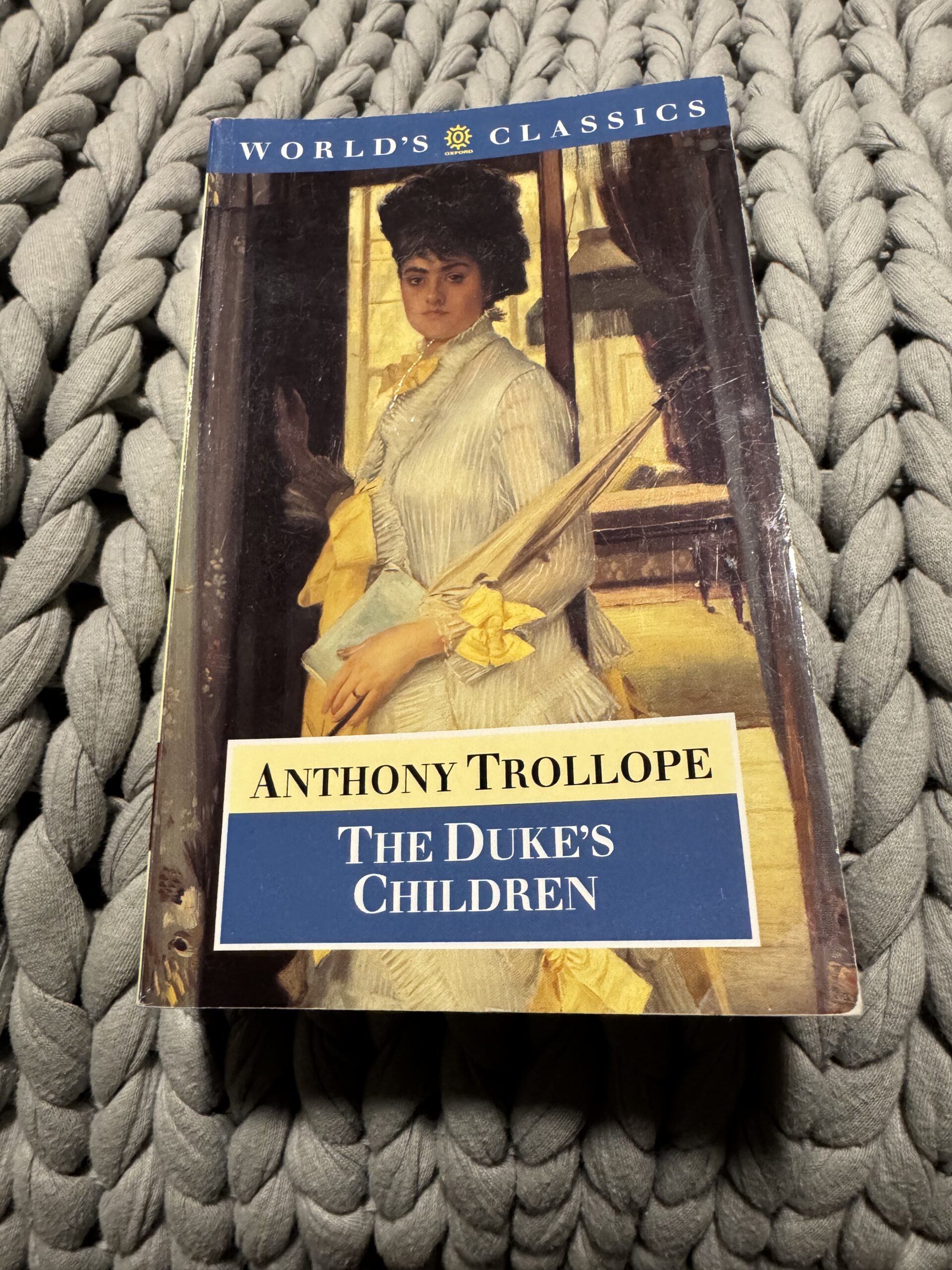
The Mom Weekly Volume 154: July 21, 2026
You can read this, or any other previous Mom Weeklies, by going to the home page here.
Notes:
I realized kind of late that I didn’t have something queued up for this week. And then I realized that I have a LOT of writing in various places.
A couple of years ago, for instance, I had written a few posts about money and literature, with the intention of making them into a Substack. That Substack didn’t happen, but I did start a Substack on points and miles, and please subscribe to it if you have not yet done so.
When I remembered them, I found the one I’m sharing today. I know it is really long, but it is very worthwhile!
Anthony Trollope is a very prolific 19th century author, and sometimes he does write too long, but he had good things to say! I hope you will indulge both the lengthy quote and my thoughts on it.
Remember how much I love you (and 19th century English literature),
Mom
Money+Literature: “Do You Ever Think What Money Is?” (From the —recent— Vault)
The Duke of Omniun schools his son, and us, on how to be worthy in obtaining and spending money.
Gerald told his story, standing bolt upright, and looking his father full in the face as he told it. “You lost three thousand four hundred pounds at one sitting to Lord Percival—at cards!”
…..
How old are you?”
“I am just twenty-one.”
“You are beginning the world well, Gerald! What is the engagement which Silverbridge has made with Lord Percival?”
“To pay him the money at the end of next month.”
“What had Silverbridge to do with it?”
“Nothing, sir. I wrote to Silverbridge because I didn’t know what to do. I knew he would stand to me.”
“Who is to stand to either of you if you go on thus I do not know.”
To this Gerald of course made no reply, but an idea came across his mind that he knew who would stand both to himself and his brother.
“How did Silverbridge mean to get the money?”
“He said he would ask you. But I thought that I ought to tell you.”
“Is that all?”
“All what, sir?”
“Are there other debts?” To this Gerald made no reply. “Other gambling debts.”
“No, sir;—not a shilling of that kind. I have never played before.”
“Does it ever occur to you that going on at that rate you may very soon lose all the fortune that will ever come to you? You were not yet of age and you lost three thousand four hundred pounds at cards to a man whom you probably knew to be a professed gambler!”
The Duke seemed to wait for a reply, but poor Gerald had not a word to say.
“Can you explain to me what benefit you proposed to yourself when you played for such stakes as that?”
“I hoped to win back what I had lost.”
“Facilis descensus Averni!” said the Duke, shaking his head. “Noctes atque dies patet atri janua Ditis.”
No doubt, he thought, that as his son was at Oxford, admonitions in Latin would serve him better than in his native tongue. But Gerald, when he heard the grand hexameter rolled out in his father’s grandest tone, entertained a comfortable feeling that the worst of the interview was over.
“Win back what you had lost! Do you think that that is the common fortune of young gamblers when they fall among those who are more experienced than themselves?”
“One goes on, sir, without reflecting.”
“Go on without reflecting! Yes; and where to? where to? Oh Gerald, where to? Whither will such progress without reflection take you?”
“He means—to the devil,” the lad said inwardly to himself, without moving his lips.
“There is but one goal for such going on as that. I can pay three thousand four hundred pounds for you certainly. I think it hard that I should have to do so; but I can do it,—and I will do it.”
“Thank you, sir,” murmured Gerald.
“But how can I wash your young mind clean from the foul stain which has already defiled it? Why did you sit down to play? Was it to win the money which these men had in their pockets?”
“Not particularly.”
“It cannot be that a rational being should consent to risk the money he has himself,—to risk even the money which he has not himself,—without a desire to win that which as yet belongs to his opponents. You desired to win.”
“I suppose I did hope to win.”
“And why? Why did you want to extract their property from their pockets, and to put it into your own? That the footpad on the road should have such desire when, with his pistol, he stops the traveller on his journey we all understand. And we know what we think of the footpad,—and what we do to him. He is a poor creature, who from his youth upwards has had no good thing done for him, uneducated, an outcast, whom we should pity more than we despise him. We take him as a pest which we cannot endure, and lock him up where he can harm us no more. On my word, Gerald, I think that the so-called gentleman who sits down with the deliberate intention of extracting money from the pockets of his antagonists, who lays out for himself that way of repairing the shortcomings of fortune, who looks to that resource as an aid to his means,—is worse, much worse, than the public robber!
He is meaner, more cowardly, and has I think in his bosom less of the feelings of an honest man. And he probably has been educated,—as you have been. He calls himself a gentleman. He should know black from white. It is considered terrible to cheat at cards.”
“There was nothing of that, sir.”
“The man who plays and cheats has fallen low indeed.”
“I understand that, sir.”
”“He who plays that he may make an income, but does not cheat, has fallen nearly as low. Do you ever think what money is?”
The Duke paused so long, collecting his own thoughts and thinking of his own words, that Gerald found himself obliged to answer.
“Cheques, and sovereigns, and bank-notes,” he replied with much hesitation.
“Money is the reward of labour,” said the Duke, “or rather, in the shape it reaches you, it is your representation of that reward. You may earn it yourself, or, as is, I am afraid, more likely to be the case with you, you may possess it honestly as prepared for you by the labour of others who have stored it up for you. But it is a commodity of which you are bound to see that the source is not only clean but noble.
…..
“There is nothing so comfortable as money,—but nothing so defiling if it be come by unworthily; nothing so comfortable, but nothing so noxious if the mind be allowed to dwell upon it constantly. If a man have enough, let him spend it freely. If he wants it, let him earn it honestly. Let him do something for it, so that the man who pays it to him may get its value. But to think that it may be got by gambling, to hope to live after that fashion, to sit down with your fingers almost in your neighbour’s pockets, with your eye on his purse, trusting that you may know better than he some studied calculations as to the pips concealed in your hands, praying to the only god you worship that some special card may be vouchsafed to you,—that I say is to have left far, far behind you, all nobility, all gentleness, all manhood!
Write me down Lord Percival’s address and I will send him the money.”
Then the Duke wrote a cheque for the money claimed and sent it with a note, as follows:—
The Duke of Omnium presents his compliments to Lord Percival. The Duke has been informed by Lord Gerald Palliser that Lord Percival has won at cards from him the sum of three thousand four hundred pounds. The Duke now encloses a cheque for that amount, and requests that the document which Lord Percival holds from Lord Silverbridge as security for the amount, may be returned to Lord Gerald.
Let the noble gambler have his prey. He was little solicitous about that. If he could only so operate on the mind of this son,—so operate on the minds of both his sons, as to make them see the foolishness of folly, the ugliness of what is mean, the squalor and dirt of ignoble pursuits, then he could easily pardon past faults. If it were half his wealth, what would it signify if he could teach his children to accept those lessons without which no man can live as a gentleman, let his rank be the highest known, let his wealth be as the sands, his fashion unrivalled?
—Anthony Trollope, The Duke’s Children, Chapter 65
If I could get away with reproducing entire chapters of some of the great novels, I promise you I would do it. In a heartbeat. There is so much context and information in the entire chapters, of entire novels, that give us good advice centuries after they were written.
But long as today’s passage is, it is only a part of this chapter of Anthony Trollope’s 1879 novel The Duke’s Children.

The Duke’s Children is the final novel in the six-book Palliser series, following the Palliser family and friends through many decades. All of the Palliser novels are worth reading and enjoying! The audio versions are delightful.
Satisfying as it would be to me, I’m not going to spend time explaining or expounding on 18th and 19th century entail, or inheritance law, or how the monetary system worked (a particular area of concern for the Duke when he was Chancellor of the Exchequer in a prior Palliser novel).
What I most want to convey to you, dear reader, in is how the chosen passages reach through the centuries and give us solid money (and often life) advice.
So here’s some context on this quote:
The Duke of Omnium is a widower, shepherding his three children into young adulthood. Th elder son, “Silverbridge,” has in the past had his own money troubles, and he’s helped out his younger brother, Gerald, by pledging to pay a debt Gerald made by gambling foolishly.
But when he goes home, Gerald decides to do the manly thing and tell his father straight out about the debt. This long exchange is only part of this wonderful chapter! I encourage you to look it up to see how Gerald reports on this conversation in a letter to Silverbridge.
Some context/translation:
Facilis descensus Averni! Noctes atque dies patet atri janua Ditis.
= “The descent to hell is easy. The gates of hell are open night and day.”
This is a quote from Virgil’s Aeneid.
Money Takeaway
The Duke tells Gerald, and us:
“There is nothing so comfortable as money,—but nothing so defiling if it be come by unworthily; nothing so comfortable, but nothing so noxious if the mind be allowed to dwell upon it constantly. If a man have enough, let him spend it freely. If he wants it, let him earn it honestly. Let him do something for it, so that the man who pays it to him may get its value.”
It’s pretty self-explanatory.
—Money can and should make us comfortable, but it’s more of a burden if we come by it “unworthily” such as in gambling.
—Dwelling too much on money is bad for your mind and your soul.
—If you have money to spend, spend it. If you don’t, earn it honestly.
—Gambling is an ignoble way to come by money, only a few steps better than being a “footpad” (someone who mugs people on foot).
Questions for Reflection
—Do you think about money too much, or not enough?
—“There is nothing so comfortable as money.” True or not in your life?
—Do you agree with the duke’s assessment that gambling is bad?