You can read this, or any other previous Mom Weeklies, by going to the home page here.
Notes:
I will say (not for the first time) that I often write the weeklies with myself in mind, and with things that I either need to consider or be reminded of. Today is no exception.
Remember how much I love you,
Mom
September is the new January
I thought this candy-corn themed color scheme seemed seasonally appropriate.
There’s been a trend in recent years to say, “September is the new January” because with the end of the summer and the start of the school year for most kids, it’s a time to refresh our schedules, our spaces, and our lives.
Now, most of us are no longer in school, but there is something to be said for a reset time when it’s not as busy/holiday rich as the end of December, to take stock of things and maybe make some goals.
Today is September 1, so this is a good time to consider one of these “resets.”
Might I suggest a few things? And as I say this, remember that I write The Mom Weekly as much for myself, with ideas I want to implement, as much as I write for you.
Choose Four small/moderate goals, one per month.
This could look like organizing or deep cleaning a room each month:
September: Kitchen
October: Main Bedroom
November: Basement Storage areas (great ahead of holiday decorating)
December: books & bookshelves
Work on something challenging for the last quarter of the year as a sprint.
If you have a side project or a , focusing on it for a quarter (three months) can be a great plan. I have some specific writing projects that I would like to make good progress on. Setting aside a few dedicated writing days could be good work for me.
Start looking ahead to make some memories with all the upcoming holidays.
September through December is chock full. There are many holidays, from Halloween (not my favorite!) to New Year’s Eve. But there are also seasonal activities. Actually putting these things on the calendar, (even if you have to change your dates, etc.) can help make these things happen, and bring more enjoyment into your life. Some ideas:
Farm fun:
apple picking, pumpkin patch visit, corn maze
Fall food:
plan pumpkin recipes (pumpkin muffins, pumpkin chili), apple recipes, cider, fall soup recipes, candy corn, etc.
Halloween:
As most everyone knows, this is not my favorite holiday! But it’s worth planning to have the Halloween candy on hand, decide when you would like to hand out candy at your door (or decide against, and go out of town!)
All Saints/All Souls:
November 1 is All Saints Day, November 2 is All Souls, and the month of November is set aside for remembering our beloved dead. Consider visiting a cemetery this month (even if it’s not a cemetery where you have relatives or friends) and praying for them. You may remember we did that years ago when we could bike ride to the town cemetery, and on temperate November days, we would do just that!
Thanksgiving:
Setting aside some time to plan what you are going to make or have for Thanksgiving, as well as where you will be, is always a good plan.
December holidays:
While every month has saint feast days and other holidays (much less all the made-up “National Brownie Day”, etc.) December is chock full. So a little advance planning, even this far ahead, could be a fun exercise.
December 6: St. Nicholas
Hanukkah is early this year! December 4-12. Add to the calendar. I’ll be planning to make latkes during those days.
December 8: Feast of the Immaculate Conception
December 12: Our Lady of Guadalupe
December 16: Jane Austen’s 251st Birthday
December 24/25: Christmas Eve/Christmas Day
December 31/January 1: New Year’s Eve/New Year’s Day
I enjoy WSJ travel writer Dawn Gilbertson’s columns. This is somewhat topical because some in our family may have the chance to experience some of these Alaska to Europe flights! I hope I can before too lon.g
“There are literally thousands of fathers reading those tweets and thinking: ‘When my daughter lost her favorite toy, I led a search party as if for a downed NATO nuclear warhead. And when that failed, I paid $300 for a replica on eBay,’” posted David Frum, a former speechwriter for President George W. Bush.
You can read this, or any other previous Mom Weeklies, by going to the home page here.
Notes:
The busy weekend means that I’m relying on a little “from the vault” to have a weekly post on time.
It’s not very long, but I can remember well how we felt about how much fun a Boxcar Children movie would be. Enjoy and a read
Remember how much I love you,
Mom
Why Has “The Boxcar Children” Never Been Turned Into a Movie? (From the Vault, 2009)
We really enjoyThe Boxcar Children series at our house. They are not “great literature” but they are fun good stories, and hilarious for adults in the implied dysfunction of various family members.
Grandfather Alden keeps quarreling with various family members, and his kind and loving grandchildren keep reuniting them with them, and solving a mystery to boot. But it’s all about the mysteries. They are such fun books.
I am shocked to learn there has never been a movie version of this classic. Why not? There would be a built-in audience from so many generations of kids and their parents who have read them in the decades since they were first published.
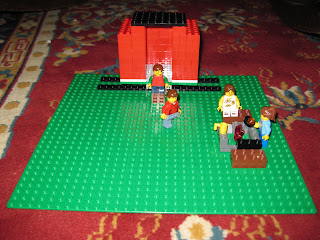
Homegirl created, with help from siblings, this Lego version of The Boxcar Children.
You can read this, or any other previous Mom Weeklies, by going to the home page here.
Notes:
Today’s Weekly is demonstration yet again that many days, I write this for myself as much as anyone else.
Remember how much I love you,
Mom
It’s Okay to Be Grumpy Sometimes
I am writing this on a morning when I am not in the sunniest mood. In actual fact, I am grumpy. I think I woke up this way, but every little thing—especially things (and people and pets)—I cannot change, is adding to the grumpiness.
Of course I know it is okay to feel less than cheerful, but it’s annoying to be annoyed by everything and everyone, for no reason or even for reason!
Part of me wants to say to myself, “Objectively, you have a pretty great life, and you should NOT be grumpy.”
But our emotions are what they are. It isn’t a sign of ingratitude for my blessings, or a character flaw, that occasionally I wake up on the wrong side of the bed. And acknowledging those negative emotions, and expressing them openly, is a helpful and good skill.
I told the people around me that I was grumpy, and I said I was going to Panera to do some writing, and not be around people or pets for awhile. (Also, is it odd or strangely appropriate that “pets” keeps autocorrecting to “pest”? LOL)
So one of my children, who shall remain nameless but who is wise beyond her years, reminded me a couple of hours ago: “It’s okay to be grumpy sometimes.”
And let me remind you of that as well: It’s okay to be grumpy sometimes.
It’s okay to be grumpy sometimes.
Be willing to tell those around you that you are.
Find a small way that you can do something that gives you joy or give you life.
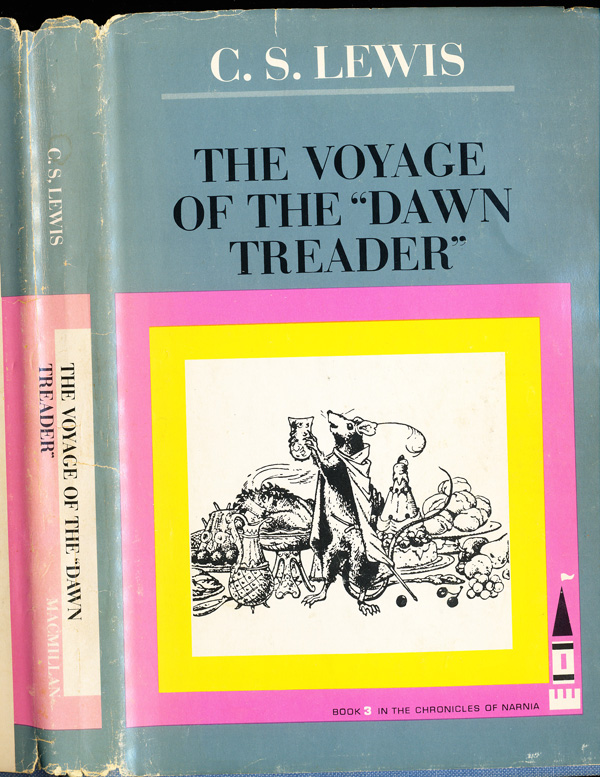
Doesn’t this remind you of the sleeping lords in C.S. Lewis’ The Voyage of the Dawn Treader?
I was re-reading parts of the book to find the sleepers, and I remember how much I love that one of the Chronicles of Narnia in particular (and all the rest, honestly. It’s not even my favorite). And Reepicheep! He’s absolutely the BEST.
A cover of one of the first editions of The Voyage of the Dawn Treader
When I remembered them, I found the one I’m sharing today. I know it is really long, but it is very worthwhile!
Anthony Trollope is a very prolific 19th century author, and sometimes he does write too long, but he had good things to say! I hope you will indulge both the lengthy quote and my thoughts on it.
Remember how much I love you (and 19th century English literature),
Mom
Money+Literature: “Do You Ever Think What Money Is?” (From the —recent— Vault)
The Duke of Omniun schools his son, and us, on how to be worthy in obtaining and spending money.
Gerald told his story, standing bolt upright, and looking his father full in the face as he told it. “You lost three thousand four hundred pounds at one sitting to Lord Percival—at cards!”
…..
How old are you?”
“I am just twenty-one.”
“You are beginning the world well, Gerald! What is the engagement which Silverbridge has made with Lord Percival?”
“To pay him the money at the end of next month.”
“What had Silverbridge to do with it?”
“Nothing, sir. I wrote to Silverbridge because I didn’t know what to do. I knew he would stand to me.”
“Who is to stand to either of you if you go on thus I do not know.”
To this Gerald of course made no reply, but an idea came across his mind that he knew who would stand both to himself and his brother.
“How did Silverbridge mean to get the money?”
“He said he would ask you. But I thought that I ought to tell you.”
“Is that all?”
“All what, sir?”
“Are there other debts?” To this Gerald made no reply. “Other gambling debts.”
“No, sir;—not a shilling of that kind. I have never played before.”
“Does it ever occur to you that going on at that rate you may very soon lose all the fortune that will ever come to you? You were not yet of age and you lost three thousand four hundred pounds at cards to a man whom you probably knew to be a professed gambler!”
The Duke seemed to wait for a reply, but poor Gerald had not a word to say.
“Can you explain to me what benefit you proposed to yourself when you played for such stakes as that?”
“I hoped to win back what I had lost.”
“Facilis descensus Averni!” said the Duke, shaking his head. “Noctes atque dies patet atri janua Ditis.”
No doubt, he thought, that as his son was at Oxford, admonitions in Latin would serve him better than in his native tongue. But Gerald, when he heard the grand hexameter rolled out in his father’s grandest tone, entertained a comfortable feeling that the worst of the interview was over.
“Win back what you had lost! Do you think that that is the common fortune of young gamblers when they fall among those who are more experienced than themselves?”
“One goes on, sir, without reflecting.”
“Go on without reflecting! Yes; and where to? where to? Oh Gerald, where to? Whither will such progress without reflection take you?”
“He means—to the devil,” the lad said inwardly to himself, without moving his lips.
“There is but one goal for such going on as that. I can pay three thousand four hundred pounds for you certainly. I think it hard that I should have to do so; but I can do it,—and I will do it.”
“Thank you, sir,” murmured Gerald.
“But how can I wash your young mind clean from the foul stain which has already defiled it? Why did you sit down to play? Was it to win the money which these men had in their pockets?”
“Not particularly.”
“It cannot be that a rational being should consent to risk the money he has himself,—to risk even the money which he has not himself,—without a desire to win that which as yet belongs to his opponents. You desired to win.”
“I suppose I did hope to win.”
“And why? Why did you want to extract their property from their pockets, and to put it into your own? That the footpad on the road should have such desire when, with his pistol, he stops the traveller on his journey we all understand. And we know what we think of the footpad,—and what we do to him. He is a poor creature, who from his youth upwards has had no good thing done for him, uneducated, an outcast, whom we should pity more than we despise him. We take him as a pest which we cannot endure, and lock him up where he can harm us no more. On my word, Gerald, I think that the so-called gentleman who sits down with the deliberate intention of extracting money from the pockets of his antagonists, who lays out for himself that way of repairing the shortcomings of fortune, who looks to that resource as an aid to his means,—is worse, much worse, than the public robber!
He is meaner, more cowardly, and has I think in his bosom less of the feelings of an honest man. And he probably has been educated,—as you have been. He calls himself a gentleman. He should know black from white. It is considered terrible to cheat at cards.”
“There was nothing of that, sir.”
“The man who plays and cheats has fallen low indeed.”
“I understand that, sir.”
”“He who plays that he may make an income, but does not cheat, has fallen nearly as low. Do you ever think what money is?”
The Duke paused so long, collecting his own thoughts and thinking of his own words, that Gerald found himself obliged to answer.
“Cheques, and sovereigns, and bank-notes,” he replied with much hesitation.
“Money is the reward of labour,” said the Duke, “or rather, in the shape it reaches you, it is your representation of that reward. You may earn it yourself, or, as is, I am afraid, more likely to be the case with you, you may possess it honestly as prepared for you by the labour of others who have stored it up for you. But it is a commodity of which you are bound to see that the source is not only clean but noble.
…..
“There is nothing so comfortable as money,—but nothing so defiling if it be come by unworthily; nothing so comfortable, but nothing so noxious if the mind be allowed to dwell upon it constantly. If a man have enough, let him spend it freely. If he wants it, let him earn it honestly. Let him do something for it, so that the man who pays it to him may get its value. But to think that it may be got by gambling, to hope to live after that fashion, to sit down with your fingers almost in your neighbour’s pockets, with your eye on his purse, trusting that you may know better than he some studied calculations as to the pips concealed in your hands, praying to the only god you worship that some special card may be vouchsafed to you,—that I say is to have left far, far behind you, all nobility, all gentleness, all manhood!
Write me down Lord Percival’s address and I will send him the money.”
Then the Duke wrote a cheque for the money claimed and sent it with a note, as follows:—
The Duke of Omnium presents his compliments to Lord Percival. The Duke has been informed by Lord Gerald Palliser that Lord Percival has won at cards from him the sum of three thousand four hundred pounds. The Duke now encloses a cheque for that amount, and requests that the document which Lord Percival holds from Lord Silverbridge as security for the amount, may be returned to Lord Gerald.
Let the noble gambler have his prey. He was little solicitous about that. If he could only so operate on the mind of this son,—so operate on the minds of both his sons, as to make them see the foolishness of folly, the ugliness of what is mean, the squalor and dirt of ignoble pursuits, then he could easily pardon past faults. If it were half his wealth, what would it signify if he could teach his children to accept those lessons without which no man can live as a gentleman, let his rank be the highest known, let his wealth be as the sands, his fashion unrivalled?
—Anthony Trollope, The Duke’s Children, Chapter 65
If I could get away with reproducing entire chapters of some of the great novels, I promise you I would do it. In a heartbeat. There is so much context and information in the entire chapters, of entire novels, that give us good advice centuries after they were written.
But long as today’s passage is, it is only a part of this chapter of Anthony Trollope’s 1879 novel The Duke’s Children.
The Duke’s Children is the final novel in the six-book Palliser series, following the Palliser family and friends through many decades. All of the Palliser novels are worth reading and enjoying! The audio versions are delightful.
Satisfying as it would be to me, I’m not going to spend time explaining or expounding on 18th and 19th century entail, or inheritance law, or how the monetary system worked (a particular area of concern for the Duke when he was Chancellor of the Exchequer in a prior Palliser novel).
What I most want to convey to you, dear reader, in is how the chosen passages reach through the centuries and give us solid money (and often life) advice.
So here’s some context on this quote:
The Duke of Omnium is a widower, shepherding his three children into young adulthood. Th elder son, “Silverbridge,” has in the past had his own money troubles, and he’s helped out his younger brother, Gerald, by pledging to pay a debt Gerald made by gambling foolishly.
But when he goes home, Gerald decides to do the manly thing and tell his father straight out about the debt. This long exchange is only part of this wonderful chapter! I encourage you to look it up to see how Gerald reports on this conversation in a letter to Silverbridge.
Some context/translation:
Facilis descensus Averni! Noctes atque dies patet atri janua Ditis.
= “The descent to hell is easy. The gates of hell are open night and day.”
This is a quote from Virgil’s Aeneid.
Money Takeaway
The Duke tells Gerald, and us:
“There is nothing so comfortable as money,—but nothing so defiling if it be come by unworthily; nothing so comfortable, but nothing so noxious if the mind be allowed to dwell upon it constantly. If a man have enough, let him spend it freely. If he wants it, let him earn it honestly. Let him do something for it, so that the man who pays it to him may get its value.”
It’s pretty self-explanatory.
—Money can and should make us comfortable, but it’s more of a burden if we come by it “unworthily” such as in gambling.
—Dwelling too much on money is bad for your mind and your soul.
—If you have money to spend, spend it. If you don’t, earn it honestly.
—Gambling is an ignoble way to come by money, only a few steps better than being a “footpad” (someone who mugs people on foot).
Questions for Reflection
—Do you think about money too much, or not enough?
—“There is nothing so comfortable as money.” True or not in your life?
—Do you agree with the duke’s assessment that gambling is bad?
You can read this, or any other previous Mom Weeklies, by going to the home page here. https://themomweekly.com/
Notes:
Once again, younger me does not disappoint.
When I saw the news article that I share in the “Interesting/Notable” section about Sigrid Undset being considered for canonization, I thought, “Didn’t I write about Kristin Lavransdatter at some point?” I had first read it in in the 1990s, and re-read several times. I don’t think I’m up for a re-read at the moment, but it’s a true classic. I highly recommend.
I’m also really proud of what I wrote.
Remember how much I love you,
Mom
Kristin Lavransdatter: A Review of Sorts… (From the Vault, 2010)
Some time back, I visited a website by a Catholic convert that I respect highly and consider spiritually mature, and saw some of her “recommended” blog posts from other authors.
So I was shocked when I found myself disagreeing with just about everything I read on one post she enthusiastically recommended. The blog was about a mom and her desire to live a simple life, clearly an admirable goal. I was especially saddened by this recommended blogger’s frustration at her husband for not agreeing to her more dramatic efforts.
I don’t want to get too specific about the blog. I don’t know IRL (in real life) personally either the website author, or the author of the blog I was shocked to see her recommend. But as I read around a little on the blog I very much disagreed with, I found myself thinking, “She is like that nun from Kristin Lavransdatter.”
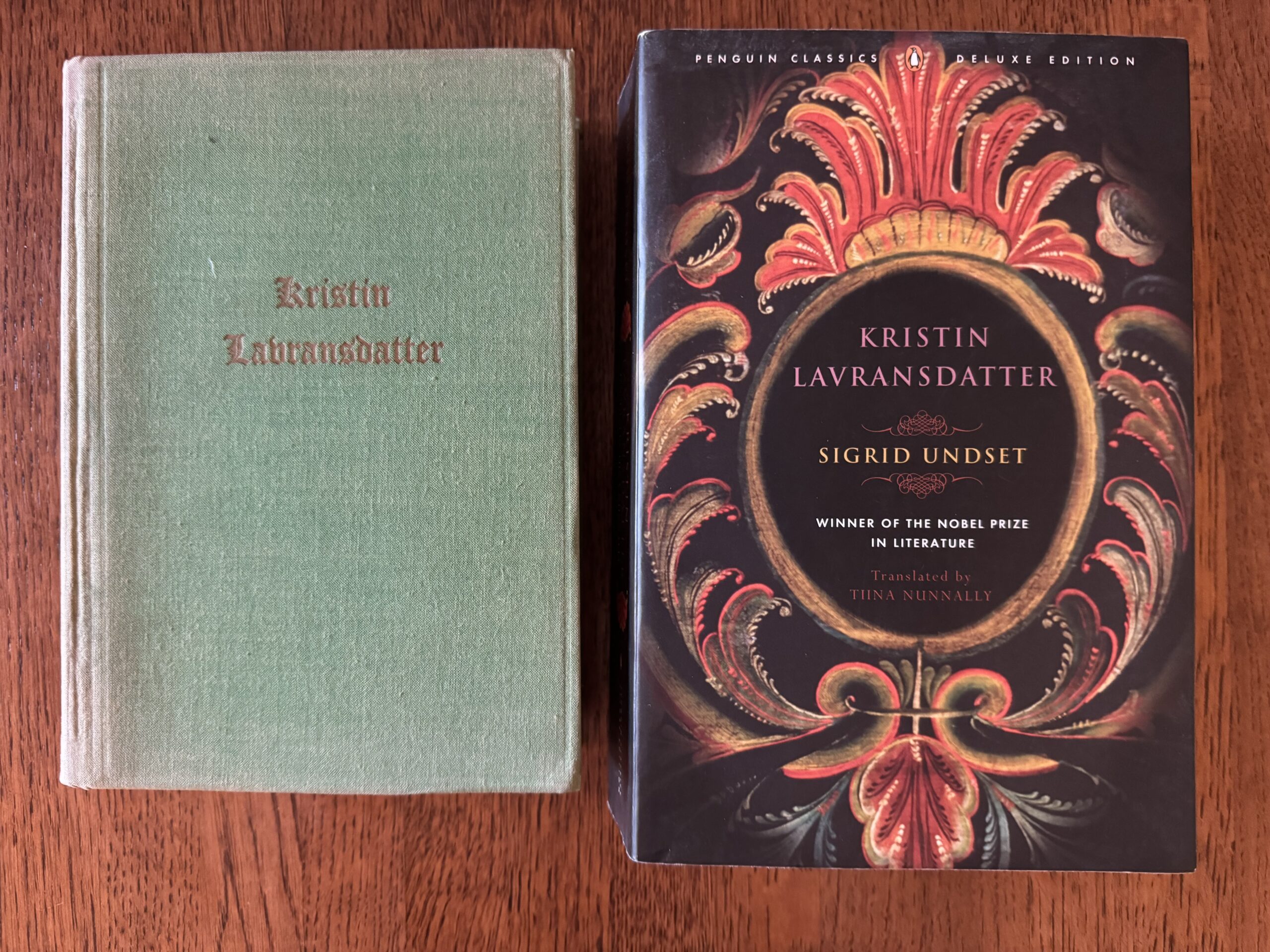
If you don’t know Kristin Lavransdatter, it is a three-volume novel by Nobel prize-winner Sigrid Undset, first published in the 1920s and never out of print, about the life of the passionate Kristin and her 14th century Norway, medieval and richly Catholic. I have the older version from when I first read Kristin, but Tiina Nunnally’s newer translation is luminous, and I’m glad to own both.
My old vintage copy of Kristin Lavransdatter, next to the newer translation.
In the novel, Sister Cecilia, a nun in the convent where Kristin goes to stay for a time, one night at dinner begins to grovel before the other sisters and confess that she has done things out of arrogance, not out of love of God:
She had served her sisters with arrogance, she had drunk vanity from her water goblet, and she had spread her bare bread thick with conceit while the sisters drank ale and ate butter on their bread.
For punishment, the abbess proclaims that the sister must sit in her (the abbess’) chair for eight days, during which time the other sisters will show her respect
“that you will grow sated from the tribute of sinful people. Then you must judge whether this is worth so much struggle, and decide either to live by the rules as the rest of us do or to continue the trials that no one demands of you. Then you can contemplate whether all the things that you say you do now so that we might look up to you, henceforward you will do out of love of God and so that He might look upon you with mercy.”
After this punishment during which she “wept as if she were being beaten,” she has a new spirit:
“She continued to live in almost the same manner as before, but she would blush like a bride if anyone looked at her, whether she was sweeping the floor or walking alone to church.”
Now, even as I write, I am surprised to see how I am comparing or even judging a real person with this character. My friends and family, I hope, know me as someone who is definitely not a “judger.”
I’ve been known to say, “You don’t know that person’s story, even if they tell you.” (This I freely lift from the Chronicles of Narnia, where Aslan tells several characters this very thing). And it sounds so much like I am judging this blogger’s motives and spiritual life.
But as a literature lover and reader, I don’t think I’m the only one who finds myself comparing certain situations, especially when they are far removed from me, to characters in novels. And I couldn’t help thinking the blogger could benefit from being “punished” by an abbess.
So I’ve promoted myself to abbess and handed down this punishment: this unnamed blogger shall use the money she is saving by trying to live a simple life not to give to the poor or some other noble goal, but to lavish on her husband and herself for a time—expensive dinners out, fancy dinners at home, babysitting so they can go see the latest frivolous goofy movie, a spa treatment or two, even– and see if that doesn’t help the situation, both in her family and in her own heart.
As Catholics, we are so fortunate to have the liturgical seasons–times of fasting and times of feasting–to balance our human selves that might tend toward one extreme or another. It’s not always Lent, and it’s not always Eastertide. We can do more penance than the church prescribes, but primarily with the help of careful and wise spiritual direction.
There’s a famous story about St. Francis about a time when his disciples were arguing about whether it was proper to eat meat on Christmas Day—that year it fell on a Friday. And Francis, took the raw meat and dragged it along the walls, saying, “It’s Christmas Day; even the walls should eat meat!”
I’m not sure if this post qualifies as a “review” of Kristin Lavransdatter, except to say that the book is such a part of my life’s fabric that I fairly often find myself comparing a situation in the novel to one in real life. If you tackle this three-volume novel, I think you’ll find it well worth the effort, both for reading reasons and for its spiritual insights.
You can read this, or any other previous Mom Weeklies, by going to the home page here.
Notes:
Once again, younger me comes through with a good reflection.
Note that at the time I wrote this, Spotify didn’t exist, but now people can make Spotify playlists (or having Spotify make them for you, which I don’t tend to love) even faster than making them in iTunes.
Remember how much I love you,
Mom
Superchick Therapy (From the Vault, 2008)
Several months ago, I picked up a greatest hits CD of a relatively obscure British band from the 1980s that I used to love in my cool college days (and I had put on many “party tapes” that I painstakingly made on an actual tape recorder of different songs I liked from different artists. How amazing to have Itunes and to make a playlist as long as you want in about 2 minutes).
I finally loaded it only iTunes and my iPod, and on a walk/jog several weeks ago I decided to go back in time and listen to it. I put on the first song, that had a pretty peppy beat, because I thought that would help me “jog” instead of walk. And then I realized the words were just so icky. That song was about something not good at all. Next song–also a really bad theme. I kept “fwd”ing through the songs until I got to the end, and couldn’t find a single one that had any positive spin.
I hate to be too depressing or ‘dramatique” about it, but it was just brokenness from beginning to end. And I thought to myself–now why did I ever like this band? Why was I filling up my head with all these depressing sad themes, even with a good beat and great musicians? I haven’t put the name of the band on here because some of the songs are still going through my head, and really bringing me down, and I don’t want that to happen to others of “my generation.” Sort of like humming the theme song from “Gilligan’s Island” and then everyone is singing it for weeks. Oops, sorry.
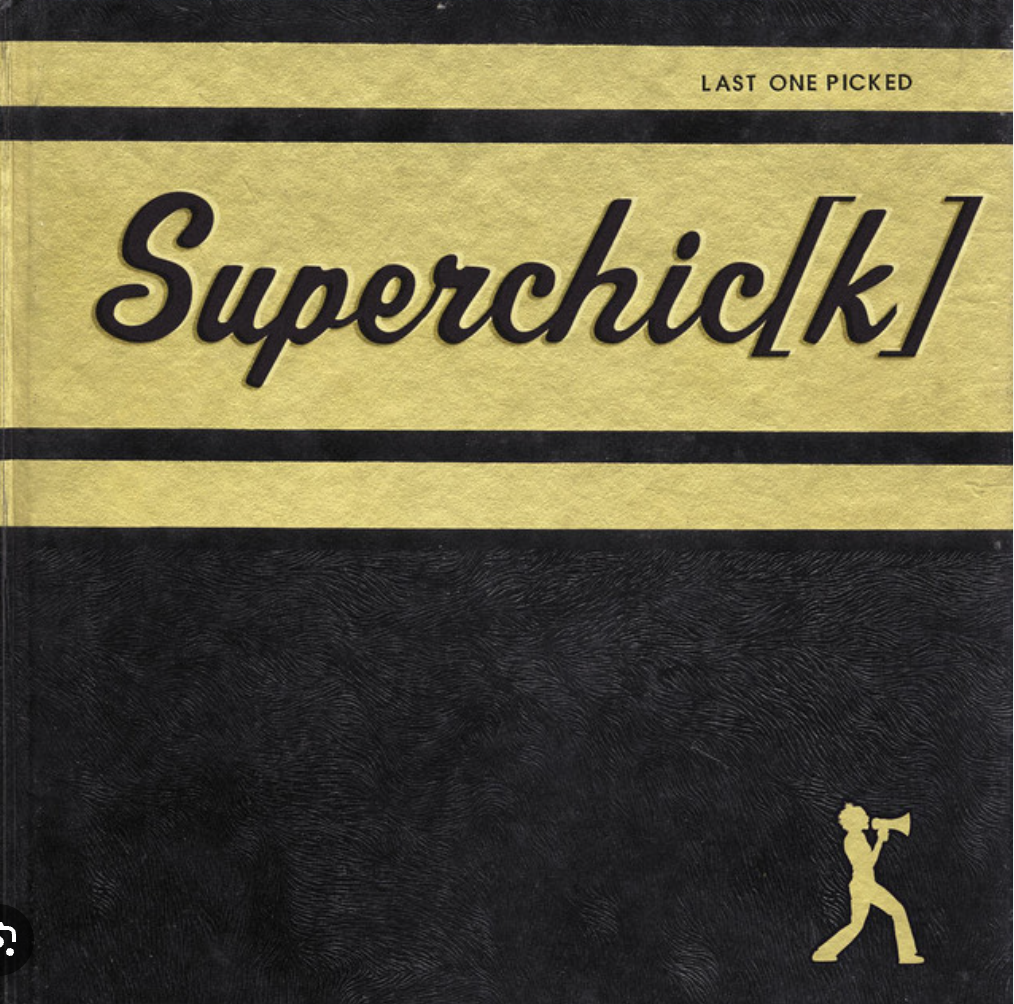
So I turned it off (and deleted it from iTunes just as soon as I got home), and turned up some good old Superchick. I tell Sir that I have been doing Superchick therapy. I can’t think of one of their songs that is not awesome, uplifting in a really clever way, and helps me jog a little faster. Plus, talk about great beats and great music.
And for me there is a song for every occasion, even in my stage of life (the bandmates are 20somethings, from what I can tell). I so, so wish there had been Superchick for the sorry 18-19 year old I was back in the day.
Feeling like you’ve made a lot of mistakes lately, need to get to confession and get on with life? Listen to “Get Up.”
“If I get up I might fall back down again, so let’s get up, come on …
If I get up I might fall back down again, we get up anyway”
Having a bad hair/life day? Listen to “One and Lonely.”
Sometimes I have good days and it’s good to be me,
Sometimes I get the best of insecurity
And it’s quite alright to be the one and only
But today I feel like the one and lonely..”
Frustrated with your spouse? (not that this ever happens at our house :-), um, yeah it does) Listen to “Na Na” (and be sure to get to the end; not just the lines):
“We’ve never had this conversation, or should I be calling it a condemnation, ’cause you’re not listening to me…Na, na, na,…
or
I feel like the teacher from “Charlie Brown,” ’cause all you hear is that “wa, wa” sound….”
Need inspiration to let go of the past or of what others say about you? Try “Let it Be”
“So what do I do with this backpack full of bricks, sticks and stones and words that stuck to me like ticks?
Let it go, let it be, brick by brick we can be free of all the words we say til we were our own enemies,
Let it go, let it be, brick by brick we can believe in the person God intended us to be..Let it be.”
Already my lovely children can sing many of the words to these songs, and I am proud to be indoctrinating them in a positive outlook on life, even amid struggles.