I thought about titling this weekly “In Praise of Oddly Worded Prayers” because, as you will see, The Traveling Prayer fits into that category. But the story of some of the other prayers, and why I find them endearing, is for another time.
Dad may have more details to share, but I think he purchased a small Franciscan prayer around the time we first moved to Peoria. And for some reason, the prayer of “use by traveling” for “automobile” became “our thing” as we began any trip, usually trips back East to visit grandparents. And by now it’s a core memory. But I thought that I would offer it here so we can all have it on hand, and not just for the UK hiking advance team on the road (and in the skies!).
An important note: the more you prayer a particular prayer, especially an oddly worded one, can highlight serious truths.
For instance, the phrase “after all the successes and failures of this life” has become much more meaningful to me as I get older. As I think back about all the successes and failures in my own life — heck, even the successes and failures of every day! — it makes me realize how important it is the play the “long game.” There are going to be successes. There are going to be failures. What’s important is to keep on after the failures and after the successes.
Remember how much I love you,
Mom
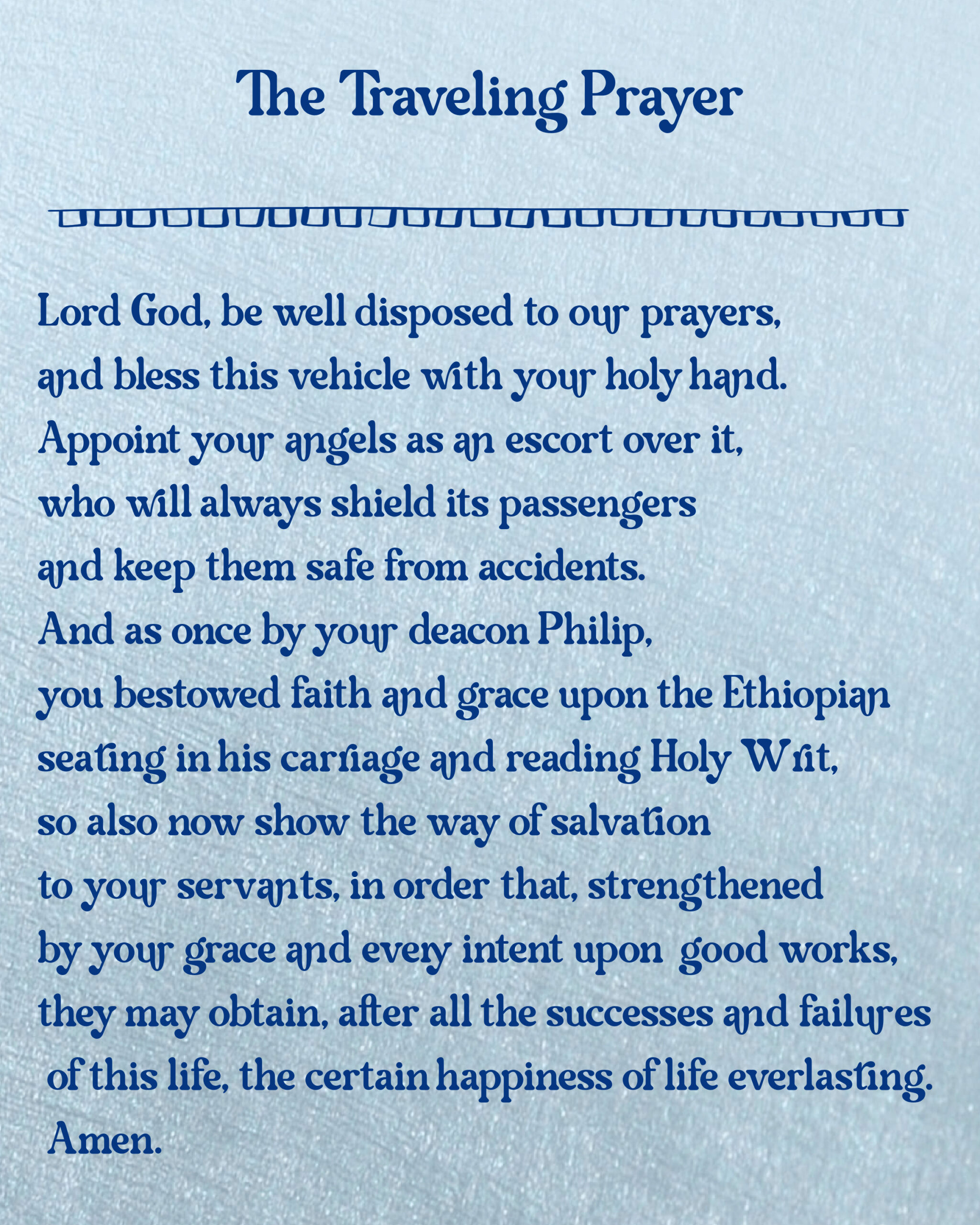
The Traveling Prayer
Lord God, be well disposed to our prayers, and bless this vehicle with your holy hand. Appoint your angels as an escort over it, who will always shield its passengers and keep them safe from accidents. And as once by your deacon Philip, you bestowed faith and grace upon the Ethiopian seating in his carriage and reading Holy Writ, so also now show the way of salvation to your servants, in order that, strengthened by your grace and every intent upon good works, they may obtain, after all the successes and failures of this life, the certain happiness of life everlasting. Amen.
You may have already memorized the Traveling Prayer, but if not, why not give it a try? If you already know it, then consider working on another prayer. There may be prayers you A few ideas:
So, now that it’s Tuesday, what are you planning for the weekend? I’m going to suggest trying to cover four “F”s to get ideas flowing:
*faith—when are you going to Mass?
*friends—what friends will you see or connect with?
*food—any fun recipes you plan to try, or restaurants you plan to visit?
*fun—anything interesting you are going to play, watch, or do this weekend? Now’s the time to think it through, and put it on the calendar (even informally).
I especially enjoy these birthday “from the vault” posts. This tells the story of how I started calling Dad “Sir.” Note that the abbreviation “dh” means “dear husband.” I’m not sure if that kind of shorthand is used anymore among the cool kids, but it was “all the thing” back in the day. It was “dh” for dear husband, “dd” for dear daughter, “ds” for son, etc.
Also, the expression “God grant him many years, God grant him many years, God grant him many blessed years” is an Eastern Catholic expression. You may remember singing it when he have attended Byzantine and other Eastern Catholic liturgies. I couldn’t find the exact tune to the one, but this one is close.
One other note: I have pre-scheduled some newsletters, since the UK hiking advance team will be traveling and exploring the next few weeks. 🙂
Remember how much I love you (and Dad!),
Mom
From the Vault: Happy Birthday, Dear Sir (May 2007)
We have our tradition of birthday week in our family. It will be enlisted, and has already been enlisted, to celebrate dh Sir’s birthday today. We returned just a few hours ago from a week with family “back East” and I didn’t get the chance yet to make my traditional birthday pie for him (he prefers pie to cake). Fortunately his mother had a beloved strawberry shortcake for him when we were in NJ over the weekend, and one of his brothers brought a chocolate-raspberry cake from NYC to NJ on Sunday. One of our wedding cake layers was chocolate-raspberry, so that was a kind of early anniversary present for next week.
Sir loves the ocean, and so I chose this photo of him from this weekend (a cold windy morning pilgrimage with kids to the ocean) for his birthday photo.
I started calling dh “sir” after he bristled when we were first married at various sweet-sounding endearments. For some reason, he especially disliked “honey.” I can still hear us laughing about it, and me asking, “well, what should I call you then — sir?” and he said: “That sounds good.”
People would give me a look when I inadvertently called him “sir” in public, but now enough of our friends know the story to laugh with us, too. I started doing it as a joke, and all these years later it has stuck, in public and without apology. To me, it does sound like an endearment.
It is too late and I am too sleepy from the long trip back to do proper justice to all the good that he does and is. We have our differences, and our frustrations with one another, but I love him dearly. God grant him many years, God grant him many years, God grant him many blessed years.
I read a recent article about making sourdough bread, and several unusual recipes were shared of ways to use sourdough for things other than bread. It made me think I “might” want to try one of these. Anyone want to talk me out of it?
When you kids were little, we were at the pediatrician all the time. (Dr. B.’s “Does Big Bird have ears?” As he looked in your ears Is such a fun memory). Not because you kids were sick, but because there are innumerable milestone appointments for vaccinations, sports physicals, and yearly checkups. And now that Dad & I are older, we are very good about scheduling our annual physicals, mostly because the office schedules them for you before you leave your current appointment.
But when you’re a young person who’s relatively healthy, it’s easy to let those go by the wayside. But I’m going to encourage you to do so, just to have a reliable primary care provider. And that way, if something does go wrong, or you need to get in to the doctor for something, you have a connection already.
If you’ve done a yearly checkup recently, do you need a dentist appointment? What about an eye appointment? Take a minute this week to make at least one appointment that is due or overdue.
What are you doing this weekend?
So, now that it’s Tuesday, what are you planning for the weekend? I’m going to suggest trying to cover four “F”s to get ideas flowing:
*faith—when are you going to Mass?
*friends—what friends will you see or connect with?
*food—any fun recipes you plan to try, or restaurants you plan to visit?
*fun—anything interesting you are going to play, watch, or do this weekend? Now’s the time to think it through, and put it on the calendar (even informally).
I was at IKEA for lunch recently with Homegirl, and we happened to be there on a Tuesday. The IKEA family program is a free sign-up that allows you certain discounts on items. I signed up years ago, and until recent years, you got 5 percent off of every purchase, including furniture. I’m kind of surprised that the discount lasted as long as it did, but it’s gone now.
Anyway, there we were at IKEA ordering lunch. And as we checked out, I asked if there were any discounts for IKEA family. And it was half off of entrees Tuesdays. Yay!
Homegirl said, “Well, this reminds me of something you used to say to us.”
I couldn’t remember, and then I did.
It was: “Well, you’re a cheap date.”
I would say this to kids when we would get a free kids meal, or have an inexpensive meal out, or when I would use a coupon or something else.
I think I might have gotten it from my Mom. (Siblings, if you remember this, let me know).
Now, if I search etymology for the expression “cheap date,” it has a kind of tawdry, 1950s vibes of someone who is loose.
Of course, there are also innumerable “cheap or free date” web pages of things to do that don’t cost a lot of money.
But I always meant it as a funny statement of how little something cost. And I was definitely joking if I was using this to refer to one of you kids. Children are the exact opposite of a “cheap date.” But they are so worth every single penny. (Remember, I’m Team Baby).
But I don’t think it’s necessarily a bad thing to be a cheap date.
It’s almost impossible to eat out inexpensively these days. The cost of restaurant meals—even fast food!—is so much higher in recent years. While it may seem not very possible to have a “cheap date” anymore, there’s always a picnic, or a hike, or a board game, or some combination.
But there’s nothing wrong with asking about discounts, or using gift cards (kudos here for Discover Cashback gift cards that allow me to eat at Panera for free), or using coupons.
Anyway, I probably should come up with an alternative to “cheap date” — I’m open to suggestions! — but for now, I think you know what I mean!
I thought this was a lovely reflection on the tension between “when to speak up and when to patiently endure.” Bonus that it does so through the Elizabeth Gaskell novel Wives & Daughters.
This was so well written. “Because we need beauty to keep our morale up.”
An action item: Start a Summer List
Summer is fast approaching, and it’s time to think ahead about things that you would like to “accomplish” or do. And you can be creative! I haven’t even started mine, but I’m going to use this as a kind of template to begin:
*restaurant to visit (either that you’ve never done so, or not in a long time)
*nearby town to explore
*hiking trail to re-hike
*new trail to hike
*savory summer recipe to try
*sweet summer recipe to try
*a goal to visit the farmer’s market monthly or more often; a different one each time?
*museum to visit, especially with an intriguing temporary exhibit
What are you doing this weekend?
So, now that it’s Tuesday, what are you planning for the weekend? I’m going to suggest trying to cover four “F”s to get ideas flowing:
*faith—when are you going to Mass?
*friends—what friends will you see or connect with?
*food—any fun recipes you plan to try, or restaurants you plan to visit?
*fun—anything interesting you are going to play, watch, or do this weekend? Now’s the time to think it through, and put it on the calendar (even informally).
I had a completely different, kind of silly, reflection all ready to go, but I’ve had a challenging recent time accompanying a friend going through difficulties. I’ve had several talks with Dad to process, but I still have a lot of thoughts swirling around and what lessons to share from this.
Then I remembered that I reviewed a book for The Catholic Post a year or so ago; a book that I found very helpful in understanding boundaries. I’m going to reprint my review below, because it does explain why boundaries are so important.
And here’s the thing that is standing out to me right now: putting healthy boundaries in place can be hard enough, but is even more complicated by being hurt from a lack of boundaries over time. That’s why being intentional about boundaries is a good practice all through life.
So I’m repeating myself here: pick something (or things) to practice saying “no” about. It’s good for you, it’s good for future you, and it’s good for all you have relationships with.
Remember how much I love you,
Mom
Good Boundaries
Most people understand that health is a lifelong practice on a physical level—you don’t “get healthy” once and then abandon the healthy habits that led to it, such as as eating well, getting adequate sleep, exercise, and reducing stress. Our bodies, our lives, are gifts from God, and as disciples, we are called to take care of them.
We can always be learning new things about health. But two things are key to remember:
—Just reading about healthy habits doesn’t make you healthy. You have to put them into practice.
—There are great, good, and bad (or at minimum, less than helpful) sources of advice. We are each responsible for sifting what is good from what is bad involves discernment.
These principles are just as true — even more so — for our mental health. And an important mental health habit is having good boundaries—healthy limits on our relationships, ourselves, and on our interactions with others.
A boundary can be as simple as saying no to a volunteer commitment (often something good!) to prevent burnout or overextending yourself. It can also be as complicated as putting limits on time spent with a coworker or friend who refuses to or ignores clearly articulated requests.
“Boundaries” are often misunderstood (and misused), especially in our current time of mental health gurus with questionable authority. A new book, Good Boundaries and Goodbyes: Loving Others Without Losing the Best of Who You Are by Christian author Lysa TerKeurst, explores the concept of boundaries from a Christian and mental health perspective.
Good Boundaries and Goodbyes persuasively makes the case that learning to be healthier about boundaries is good not just for our emotional wellbeing, but honoring to God and neighbor.
But that doesn’t make boundaries easy! Far from it. And Terkeurst writes from experience.
She went through a painful divorce after years of her spouse’s addiction issues. Processing her grief during and after helped her realize she lacked healthy boundaries not just in marriage, but in friendships and other relationships.
Good Boundaries and Goodbyes explores what boundaries are, how to understand them, and how to implement them in various situations.
While Terkeurst is not Catholic, nothing in the book is contrary to Catholic teaching. And I appreciated her faith-based perspective, her emphasis on Scripture verses throughout, and her exploration through Scripture of the ways God enacts boundaries with humans as a way to protect and preserve relationships.
“I know part of what makes this complicated is that usually by the time we realize we need boundaries, we are carrying hurt,” Terkeurst writes. “Boundaries aren’t meant to be weaponized. They are meant to be used to prioritize keeping relationships safe.”
Several features makes Good Boundaries and Goodbyes stand out: a section at the end of each chapter called “Let’s Live This,” with Scripture verses to ponder, key quotes to remember, questions for personal reflection, and prayers.
The book also includes multiple sidebars of careful explanation of topics from TerKeurst’s Christian therapist, Jim Cress.
Especially useful is a section at the end of the book containing Q&A style explanations and sample “scripts” in refuting objections to boundaries and the Scriptural and psychological principles that undergirds them.
I’ve written often about how caring for our mental health is vital in living out a full, abundant life. Simply being Catholic or practicing our faith does not guarantee the absence of mental health struggles. We need to educate ourselves and do the hard work of putting what we learn into practice. Good Boundaries and Goodbyes makes that work a little easier.
I really enjoy this series from The Free Press. (I think I shared the one about Marshall McLuhan awhile back.
This entry was written by Tiya Miles, author of All That She Carried. It’s one of G’s favorite books this year. (She’s also an Octavia Butler fan from her sci-fi classes).
I know through J3 that chess ratings are a thing, and an important thing. But I didn’t realize what it was all about until I read this article.
An action item: Practice setting an easy (but not too easy!) boundary
I am making this an action item because I really, really want each of us to practice setting boundaries, starting small, but being very intentional about it.
This week, think ahead and try to set a boundary, and practicing it. It can be as simple as declining requests for donations at the checkout (something seen more and more these days). Bonus points if you have to say “no” to an actual person, rather than at self-checkout. I’m trying to think of other ones that would be easy but still a little uncomfortable, but I’m having trouble with this one.
Let me know if you think of any others!
What are you doing this weekend?
So, now that it’s Tuesday, what are you planning for the weekend? I’m going to suggest trying to cover four “F”s to get ideas flowing:
*faith—when are you going to Mass?
*friends—what friends will you see or connect with?
*food—any fun recipes you plan to try, or restaurants you plan to visit?
*fun—anything interesting you are going to play, watch, or do this weekend? Now’s the time to think it through, and put it on the calendar (even informally).
This is essentially a “from the vault,” and so that’s how it is labeled. I use this term all the time, and here is how it came about. I wanted to share the letter I wrote to this former therapist (I see someone different now, but still really respect and admire her) a couple of years ago as a thank-you. Iit started with her!
There will be at some point a Part 2, and a Part 3 to this (not right away! Eventually!), because I have a lot more to say about this.
Let me say—not for the first time—that I will die on the hill that counseling/therapy, good therapy from well-trained and honorable people, is valuable and worthy.
Remember how much I love you,
Mom
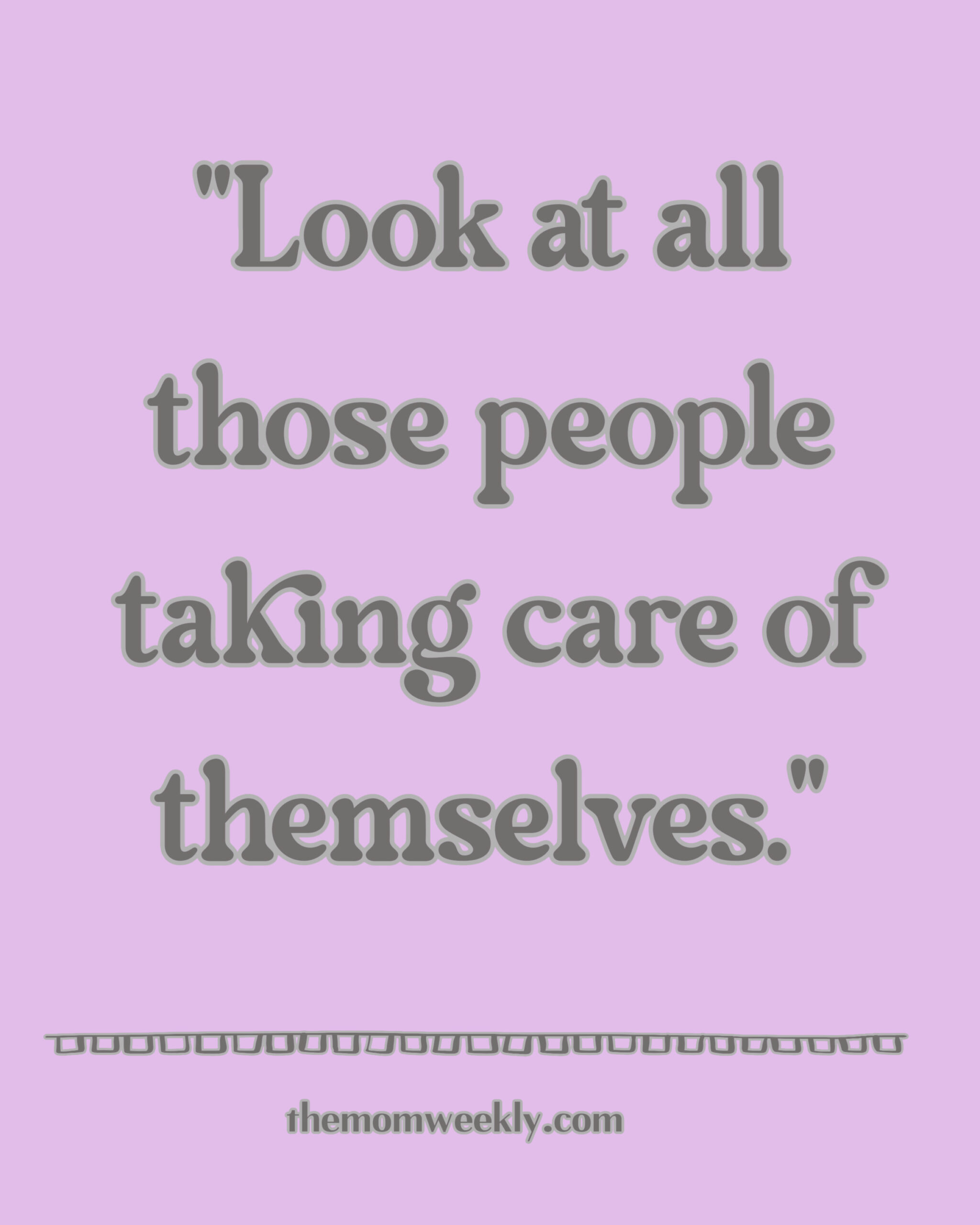
Look At All Those People Taking Care of Themselves (2022)
You may remember that I saw you for counseling about 10-12 years ago. And something you said back then has always stuck with me, and I have shared it many times.
I’ve been grateful to you for years, but only recently did it occur that you probably don’t know the impact those words have had on my life and the lives of those around me. So I’m writing this letter to let you know.
The easiest way is to share an excerpt from a talk I gave to a teen girls’ retreat in 2019. I still have the text on my laptop, so here it is:
—-
Look at all Those People Taking Care of Themselves
Many years ago, I went to counseling to talk over some issues, which was very helpful for me in many ways, and I highly recommend it.
It’s a sign of strength, not weakness, to see help when one needs it.
For several sessions, I kept running into people I would know in the waiting room. Like, nearly every time! At one point I mentioned it kind of sheepishly to my counselor. She said, “When you see the people you know, you might find it helpful to say, “Look at all those people taking care of themselves.”
A person at adoration—look at all those people taking care of themselves.
People eating healthy and having a good balance of physical activity and intellectual stimulation: look at all those people taking care of themselves.
People who practice hobbies and interests—look at all those people taking care of themselves.
People spending time with their loved ones—look at all those people taking care of themselves.
Those people out in nature getting time in God’s creation — look at those people taking care of themselves.
As you go through your life, consider the ways in which you take care of yourself, and those around you do the same. Don’t forget to take care of yourself, and seek help as needed.
—-
In the talk, I shared it with a small group of teen girls & adults. But there have been numerous conversations over the years with pretty much this same message: “Look at all those people taking care of themselves.”
I don’t “broadcast” my struggles with physical health or mental health, but I also don’t hide them in conversations with friends.
And a few times a year, often more, someone near to me will confide in me about a mental health issue that they or a loved one are going through. And I can share my experience of starting counseling many years ago. I share how even when things are going well, I touch base a few times a year for “maintenance”, and more often when needed. Look at me taking care of myself! 🙂
And nearly always, I tell the story of how you told me, “Look at all of those people taking care of themselves.” Almost always, it resonates, as it did to me many years ago.
In that way, I try to encourage the person to either seek help or encourage their loved one to seek help from a well-trained and trusted counselor.
I’m so grateful for that sentence of yours, and I know other people are as well. So, thank you, and God bless you.
And I’m really impressed with the breadth of information, methods, and conversation around NFP. As we like to say, back in my day, Netflix came in the mail!
This was such a moving and also fascinating excerpt from Doris Kearns Goodwin’s newest book, about going through her husband’s boxes from his time in the Kennedy and Johnson administrations.
An action item: Clean out your “junk drawer”
I think I probably have a “junk drawer” in most of the rooms of our house. And I do not clean them out very often. When I do, I find it a very satisfying exercise, as I can rearrange things, usually throw away a ton, and just make a small space look nicer. This week, I will work on the junk drawer in the cabinets in our laundry room.
Which one will you pick in your own place? I promise you’ll feel better after you do it. And don’t overdo this—just set a timer for 10 minutes, work to organize the drawer during then, and tidy up when the timer goes off. You can always do another round tomorrow, or another day.
What are you doing this weekend?
So, now that it’s Tuesday, what are you planning for the weekend? I’m going to suggest trying to cover four “F”s to get ideas flowing:
*faith—when are you going to Mass?
*friends—what friends will you see or connect with?
*food—any fun recipes you plan to try, or restaurants you plan to visit?
*fun—anything interesting you are going to play, watch, or do this weekend? Now’s the time to think it through, and put it on the calendar (even informally).
I heard on a podcast recently (shocking, I know!) that in political discourse, people don’t realize that they are often unwitting assets for a cause or country, even though they are well meaning.
Someone who is an “agent” is a person who fully understands they are advancing “the cause,” whatever that cause is. But an “asset” is like a tool.
(A less kind way to put it is “useful idiot” and you can read more about that here.)
I don’t mean “agent” in a negative way—I consider that a person who is an agent has agency—they are choosing to advocate for a person, cause, or point of view. Being an “asset” is potentially more problematic.
But it got me thinking, where am I an agent, and where might I be an asset?
So, for instance, I am definitely a Catholic agent. I know my faith pretty well, and I want to spread the word about positive things about the Catholic Church and the Catholic faith. (And let’s be clear, I won’t downplay bad things about and within the church.)
I am also an agent for Jane Austen. Start me on the topic of that early 19th century author, and you could be in for a long evening of proselytizing. I could help you choose which Jane Austen novel to read first. I can tell you the movie adaptations that are the best, and steer you away from bad adaptations.
It might be trickier for me to identify where I’m an asset, whether for good or ill. Perhaps it’s where I uncritically repeat a “soundbite” I’ve read or heard about in the news on a topic I perhaps know next to nothing about. The source might be correct, or it might not be.
But I think I do have a responsibility to think critically about things, and not just agree with something because I happen to like the person, or disagree with the person because I happen to loathe someone.
It goes back to having a commitment to the truth, and to finding the truth, even in our own backyards.
I first learned about this nonprofit years ago, but someone referred to it online recently and I remembered how sensible and solid a lot of their information is.
I also played a few games on the group’s “arcade” — fun! I did the insurance one, and it was pretty solid. A good way to learn about personal finance topic.
One game I found super interesting is “Build Your Stax” game. I may want to write a whole post about it. See over “20 years” how your investments would do, based on real data. I wish that had been around when you kids were younger. Do you remember that stock game that was online? Not very helpful in learning about general personal finance.
A YouTube of a podcast interview from a thoughtful CFP about his scaling back so he can spend time with his young family. Here is his blog post that led to the discussion. Worth watching and/or listening to.
So, now that it’s Tuesday, what are you planning for the weekend? I’m going to suggest trying to cover four “F”s to get ideas flowing:
*faith—when are you going to Mass?
*friends—what friends will you see or connect with?
*food—any fun recipes you plan to try, or restaurants you plan to visit?
*fun—anything interesting you are going to play, watch, or do this weekend? Now’s the time to think it through, and put it on the calendar (even informally).