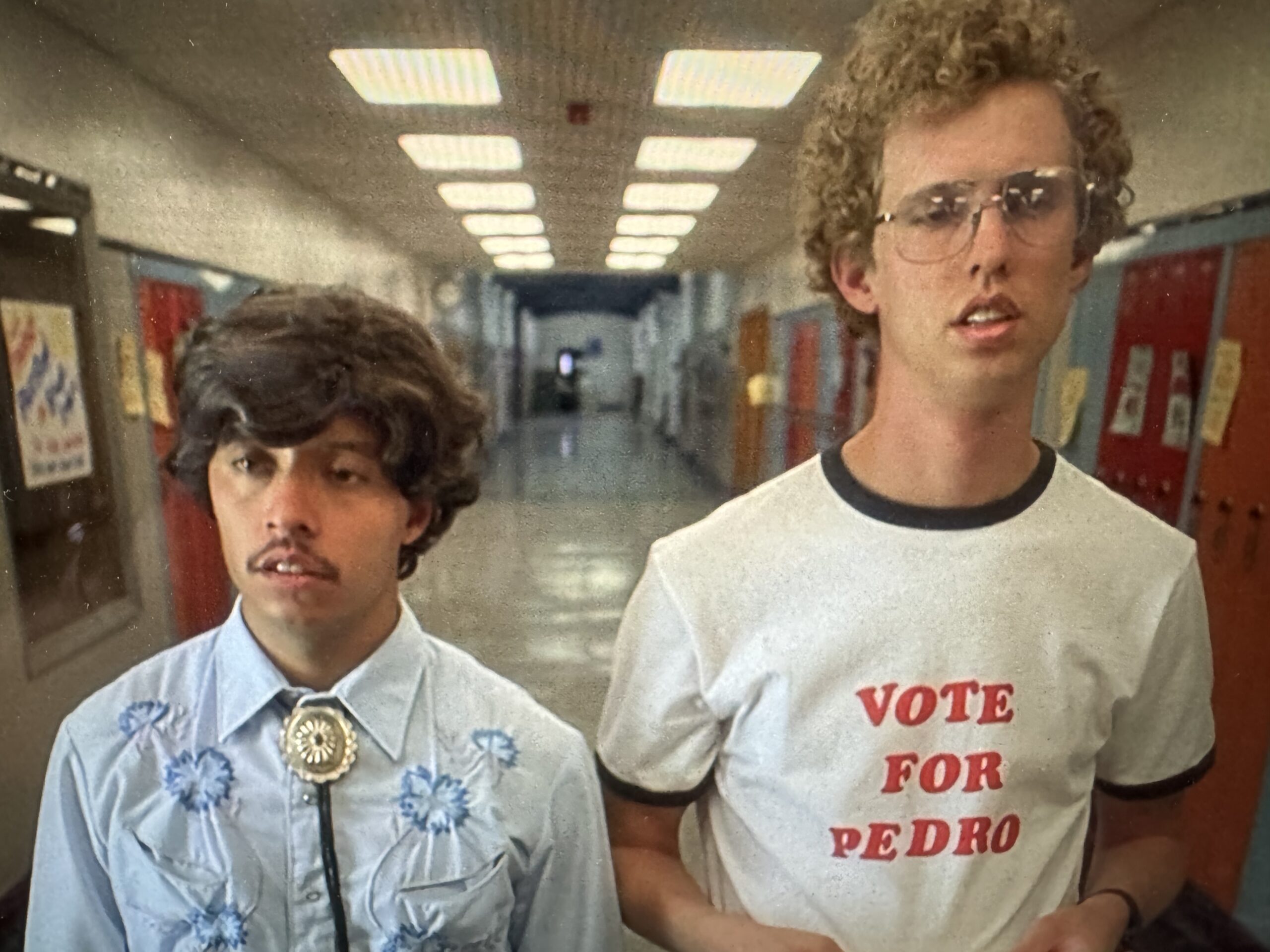
This past weekend, several of us watched the “cult classic” Napoleon Dynamite. (It’s available on Disney +). If you, like me, are not familiar with the “plot” (see me put my hands up for air quotes, since there is not much plot), you’ve certainly seen the photos and Halloween costumes and “Vote for Pedro” t-shirts.
That was quite the experience!
The reason it was on my list is that I read this lengthy, but charming, article and oral history about the making of the movie, 20 years ago:
The movie is unbelievably odd and weird, with touching moments. But if you had to choose either watching the movie or reading the article, pick the article. I’m kinda glad I did both.
But it brought up an interesting question—what ostensibly makes a cult classic? Is that even “a thing” any longer, when entertainment is so varied and fragmented? When people often consume content individually and rarely have a communal experience of a movie or show?
Our family has certainly had our own “cult classics”—movies that we like to watch repeatedly, or seasonally, such as Groundhog Day, or The Muppet Christmas Carol, or the 1995 Pride & Prejudice. I wish we had more of those traditions—for instance, I’ve known people who have Lord of the Rings movie marathons every Thanksgiving or Christmas. And it would be fun to have a regular rewatching of the Narnia movies.
Anyway, what would you put in the category of a “cult classic”? There are innumerable lists online of the “50 best” or “100 greatest” but I don’t find those particularly helpful. I would be very interested to know the movies or shows you would put on the “cult classic” list, whether you’ve seen the movie or show or not.
Remember how much I love you,
Mom
Interesting/notable and An Action Item: Check Beneficiaries on all of your accounts
I find it fascinating, and spent way too much time in the comments, about what is the “moral” thing for the beneficiary to do—give back the money since she was such a long-ago person in their life, or not?
This episode of the Choose FI podcast shows a similar dilemma. The woman interviewed was recently married to her husband, and when he died in a freak accident, she inherited all of his retirement accounts. Unfortunately, state laws did not ensure the assets only in his name, and his divorced parents fought her for those accounts.
So your action item is: Check beneficiaries on all of your accounts (especially retirement accounts).
It’s a good practice to periodically (say, once a year) double check that the beneficiaries on all of your accounts are up-to-date. Take 5-10 minutes to do that this week!
What are you doing this weekend?
Now that it’s Tuesday, what are you planning for the weekend? I’m going to suggest trying to cover four “F”s to get ideas flowing:
*faith—when are you going to Mass?
*friends—what friends will you see or connect with?
*food—any fun recipes you plan to try, or restaurants you plan to visit?
*fun—anything interesting you are going to play, watch, or do this weekend? Now’s the time to think it through, and put it on the calendar (even informally).
I started this post back on June 22, which was/is the feast of Saint John Fisher and Saint Thomas More. I love this feast because Saint Thomas More is the patron saint of lawyers, a favorite in our family, due to all the lawyers! 🙂
With news of recent days, this is even more appropriate than it was several weeks ago.
Most people can agree that there is an awful lot of rancor and even a disbelief that anyone can hold a political, religious, or other view different from one’s own. So reading about “A Prayer for Our Enemies,” written centuries ago, is tailor-made for 2024.
You kids all know how much I love and admire Universalis for prayer, specifically the app. It has the Mass Readings, Morning, Evening, and Night Prayer, the Office of Readings, a Lectio Divina section, and more. Each day has an “About Today” tab, with a little background for the saint(s) of the day, often obscure ones from the United Kingdom as Universalis creator Martin Kochanski lives there.
We have subscribed to Universalis since even before our earliest iPhones. Dad & I both had Palm Pilots back in the day (!), and we had Universalis on them. Talk about early adopters! 😉
The Universalis website looks a little 1990s, which is when it was created, but I assure you, the app is very user friendly and up-to-date. It has everything you need and nothing you don’t.
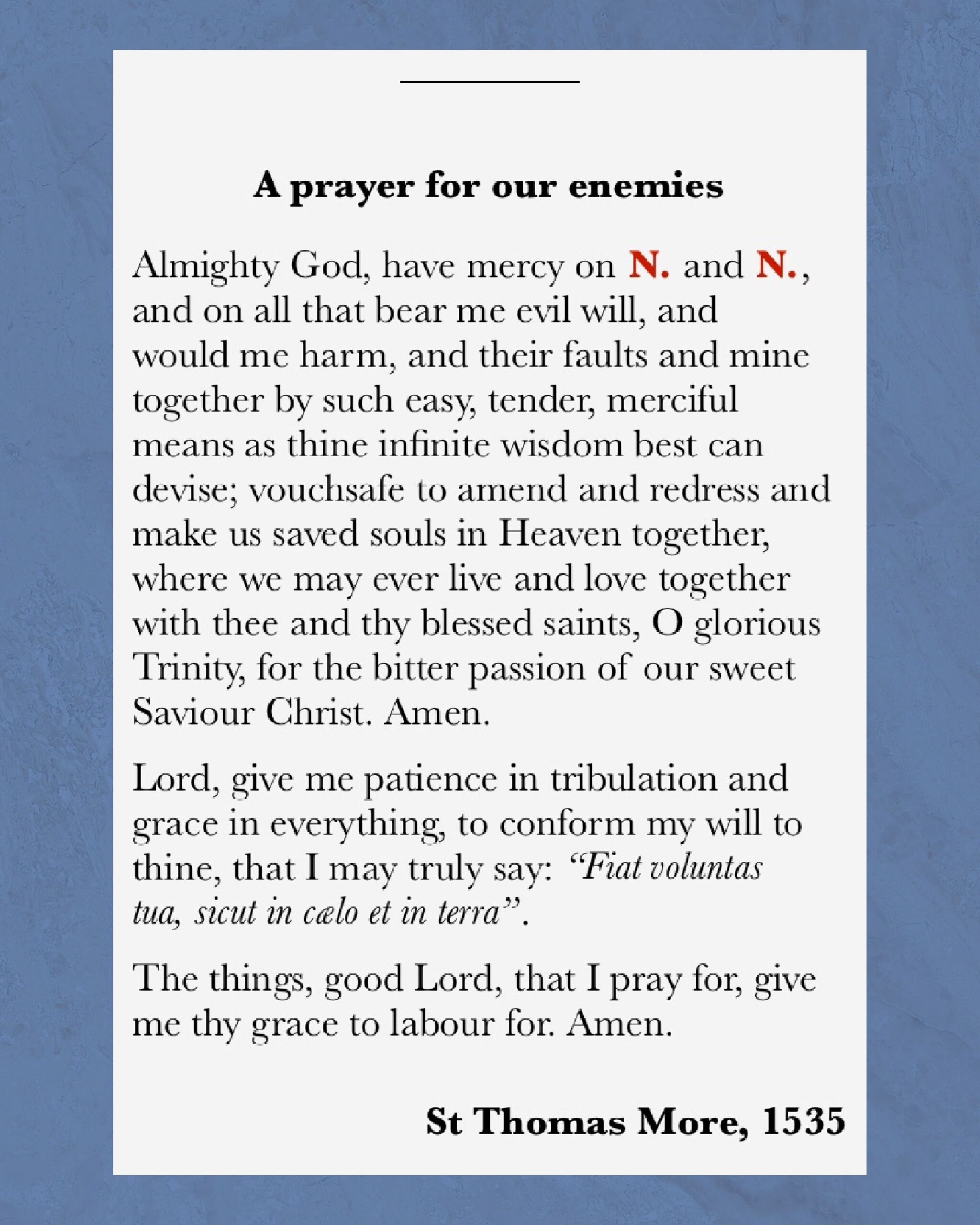
So, back to June 22, the feast of Saint John Fisher and Saint Thomas More. The “About Today” has a portrait of each of them, and a biographical sketch. And reprinted beneath those was St. Thomas More’s “Prayer for Our Enemies.” It has been such an impact on me that my photos app has mutliple screenshots of this prayer, almost every year in recent years.
But if there were ever a prayer for July 2024, or all of 2024 for that matter, this is it. I’d like to make an effort to pray it every day. I encourage you to do the same.
Remember how much I love you,
Mom
a screenshot of the Universalis app, June 22, 2015
A Prayer for Our Enemies
Almighty God, have mercy on N. and N., and on all that bear me evil will, and would me harm. Their faults and mine together, by such easy, tender, merciful means as thine infinite wisdom best can devise, vouchsafe to amend and redress; and make us saved souls in Heaven togther, where we may ever live and love together with thee and thy blesssed saints, O glorious Trinity, for the bitter passion of our sweet Saviour Christ. Amen.
Lord, give me patience in tribuation and grace in everything to conform my will to thin, that I may truly say, “Fiat voluntas tua, sicut in caelo et in terra.”
The things, good Lord, that I pray for, give me thy grace to labour for. Amen.
(The Latin phrase, referencing the Lord’s Prayer, is: “May God’s will be done on earth as it is in heaven.”)
An action item: Write and send a physical letter/postcard
As everyone knows, my love language has become sending birthday cards! But I also make an effort occasionally to send physical mail to people, unconnected to any event. It brings me back to the days of getting and sending letters from my parents, my siblings, and other friends when I was in college.
I’m not sure why this is, but it gives me such a boost of optimism whenever I send out mail. And so I’m going to offer this as an action item for you, in the hopes it will give you a boost as well!
It doesn’t take more than a few minutes to write a quick note, and I promise you will be glad that you do. You may want to have things ready to go, such as writing paper and stamps. If you don’t already, your “action item” could be to gather those thing, and put them on a tray or in a small box. That way, when you get the idea to do so, it’s relatively easy to send a letter.
What are you doing this weekend?
So, now that it’s Tuesday, what are you planning for the weekend? I’m going to suggest trying to cover four “F”s to get ideas flowing:
*faith—when are you going to Mass?
*friends—what friends will you see or connect with?
*food—any fun recipes you plan to try, or restaurants you plan to visit?
*fun—anything interesting you are going to play, watch, or do this weekend? Now’s the time to think it through, and put it on the calendar (even informally).
Some weeks ago, I saw this mini-reflection by Dr. Peter Attia and liked it well enough to transcribe it and write some of my thoughts on what he says. Getting back from vacation has left me with not a lot of time to refine my thoughts. Still, it’s worth getting these ideas out there.
When I was 20, I was an insufferable, miserable, self-absorbed prick. And I am so excited to know that when I’m 60, I won’t be. To be clear, it’s not the default state that your emotional health will get better over time. You need to work your ass off at it; just as you need to work really hard to maintain your physical and cognitive health as you age.
But the beautiful thing is, you will actually increase as you age that emotional piece if you’re willing to do the work. That is the single most important thing I cling to as I find myself having a little pity party over the fact that I don’t like my body as much as I used to, and I don’t feel as smart as I used to feel.
Like, nothing about me, today physically or cognitively is what it was 10 years ago, but I’m a way better human being today than I was 10 years ago. And I know that I’m going to be a way better human being in 10 years than I am today.
It is worth double underlining this. Maintaining and increasing physical capacity and cognitive health becomes more difficult over time, while emotional perspective and health can become easier the older we get.
For instance, I should be working to have even better physical strength than I do now, because I want to be hiking when I’m 80. But it takes more effort for 60-year-old me to increase my physical fitness than it did for 30-year-old me.
But emotional health works the opposite way. It may be difficult for people of any age to start working on emotional and mental health, but the older person is going to make faster progress, and more lasting progress, than someone younger. Over time, it becomes so much easier, and you get better with age.
Part of that is the “wisdom” of age. You just know a heck of a lot more, even without trying, because you’ve been alive for so much longer and had more experiences.
The important thing here is “working on it.” There are plenty of cranky, mean, and ill-adjusted older people. But for an older person who works on his or her emotional health, the benefits are pretty remarkable. Combining life experience with good emotional tools is an unbeatable combination.
This is no excuse for younger people to neglect their emotional health. Far from it. The sooner you start working on these tools and more, the better you will be:
*and giving yourself and others some grace, or giving yourself and others a break, already! For the most part, we are all just doing the best we can.
But know this, those of you who are younger: it gets easier, and you will get better at this, the older you get.
I might find it a real, ongoing (and yet worthy) challenge to lift heavier weights or work on my physical flexibility (before I broke my ankle, and once again when I’m fully recovered). But emotional regulation? It’s not exactly “a snap,” but it’s a heck of a lot easier than when I was 20 or 30.
An action item: Try the “hush” trick for one area of your space
That sounds a little bit like a click-bait title of an ad—this one weird trick helped me get rid of my wrinkles! But actually, this short Youtube video from The Minimal Mom outlinese a really novel way to work on decluttering, especially surfaces.
The best idea here? Leaving the spaces empty for at least 24 hours before returning things.
What are you doing this weekend?
So, now that it’s Tuesday, what are you planning for the weekend? I’m going to suggest trying to cover four “F”s to get ideas flowing:
*faith—when are you going to Mass?
*friends—what friends will you see or connect with?
*food—any fun recipes you plan to try, or restaurants you plan to visit?
*fun—anything interesting you are going to play, watch, or do this weekend? Now’s the time to think it through, and put it on the calendar (even informally).
A couple of months ago, when I actually could go hiking (sniff!), I was on a group hike with a collection of friends who are all women “of a certain age.”
Someone brought up how we want to be pleasant people to be around, even once we are older (than we are now—we are not young, and okay with that!), and perhaps troubled by various physical or other problems.
I dubbed it “Old Lady Goals” which is actually pretty genius, if you ask me.
Here are a few we came up with:
*be kind and friendly
*try not to ascribe the worst motives to people’s actions
*avoid being cranky for no reason
*get together with people regularly
*maintain a good/active prayer life
*always be reading
*be good at getting rid of things
There were definitely more, but these are the only ones I captured on my phone’s Notes app, and I can’t remember the others. But it’s an interesting thought experiment.
What do you think of this list? What would you add?
As an update on this: the last month and more, I have been relying on others for driving and grocery shopping and so many other things. I find being agreeable and low-maintenance is also an important skill, older or not. I’m not sure if everyone would agree I’ve been low-maintenance, but I have been trying!
I love this article so, so much! Such a range of things that people do when they are close to or in retirement.
Slightly related: Several months ago, when Dad & I were speaking with a CFP with Dad’s 401(k) from work, and trying to get the right amount of taxes taken out of distributions, he asked us a lot of questions about our goals, etc. I explained our thinking about distributions and taxes. At one point, he stopped the conversation to tell Dad, “Well, your wife knows a whole lot, and you are in very good hands.” That gave me a boost of confidence about my self-education in the last decade or so, and made Dad more comfortable with our planning.
Coincidentally, about the same time, I found out about this designation—
I’m thinking about doing the coursework for this, not necessarily to work in this field, because to use the designation, one has to have three years’ financial planning experience. Instead, This could be helpful to use in our own financial planning, since we are in that stage of life!
An action item: Enjoy the Beach and Cousin Time
Self-explanatory!
What are you doing this weekend?
So, now that it’s Tuesday, what are you planning for the weekend? I’m going to suggest trying to cover four “F”s to get ideas flowing:
*faith—when are you going to Mass?
*friends—what friends will you see or connect with?
*food—any fun recipes you plan to try, or restaurants you plan to visit?
*fun—anything interesting you are going to play, watch, or do this weekend? Now’s the time to think it through, and put it on the calendar (even informally).
Did you know that June is Men’s Mental Health Month? I did not until a few days ago, when two of us were at Sunday Mass (actually Saturday evening) a parish we’ve never been to before, and the church had a poster for this month.
First: mental note to talk to our pastor about putting up such posters. Second: coincidentally, some of my recent reads relate to this topic. This isn’t a super well-constructed review or reflection, but some thoughts. I wanted to be sure to post this when it was still Men’s Mental Health Month, so I don’t have to wait until next year.
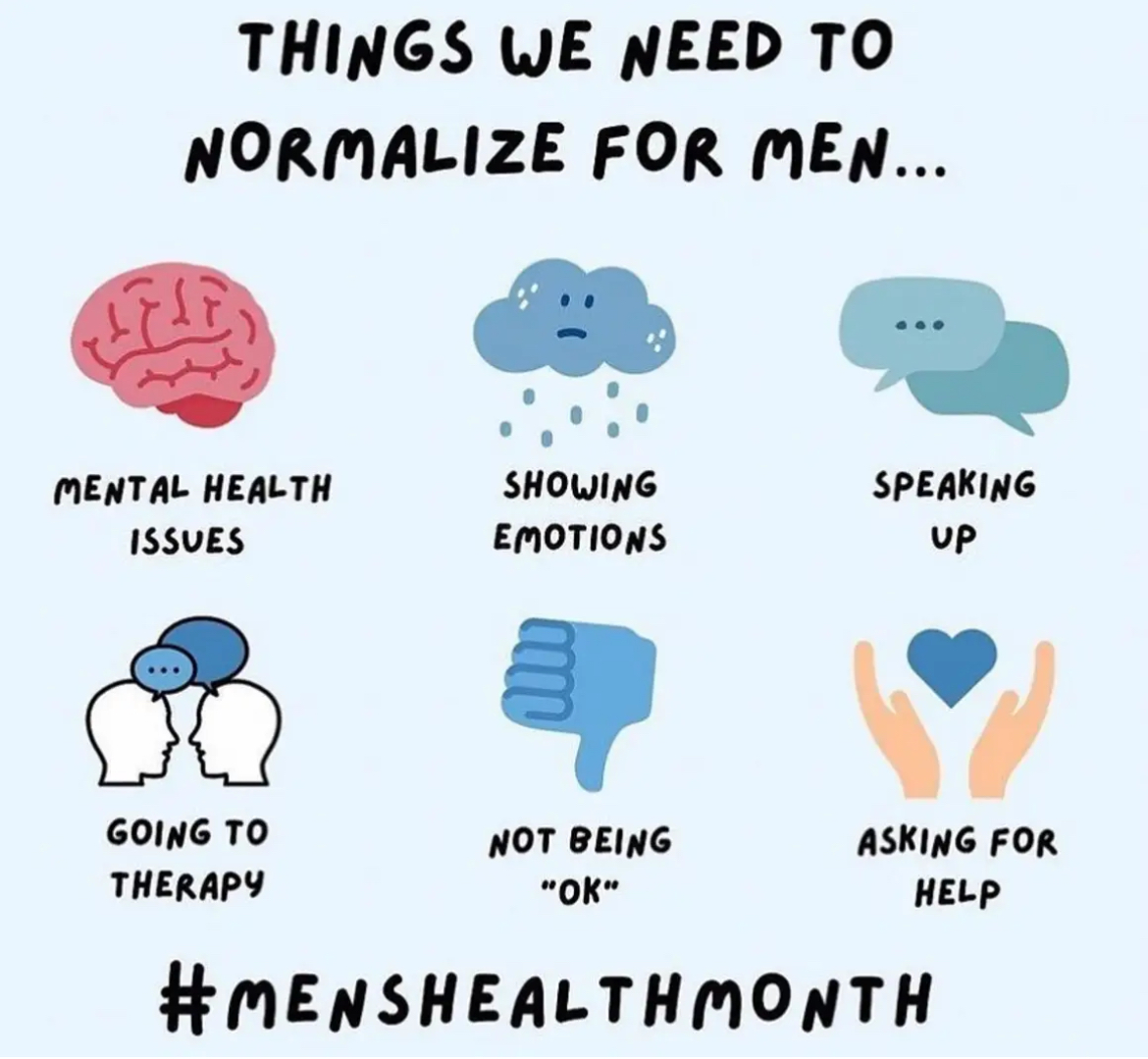
(The graphic for this weekly was helpfully shared by G, who came across it after we saw the poster).
Beauty in the Browns: Walking With Christ in the Darkness of Depression
This book, written several years ago by journalist and movie critic Paul Asay, is part memoir, part social and medical history of depression, is well-constructed and well-written. He especially discusses the difficulty of men experiencing depression, getting help when they do experience depression, and more.
I found out about it through two articles (not new, but I only came across them a few weeks ago) by Theresa Barber of Alethia. Read these articles here and here.
I know Tess through Catholic blogging circles, and so I suspected that the book would be good. And it is! Truly a great read.
Here are some of my takeaways:
exercise and structure are two of the non-therapy, non-medical interventions that work well to keep his depressive epsiodes at bay.
Great quote: ”But even the best of psychologists and the most effective medication won’t work unless you actively help them work—engaging the world and all its beats with an active stance, not a passive one.”
Asay shares many insights from others on depression, such as Andrew Solomon’s book The Noonday Demon: An Atlas of Depression; and more.
I loved this one from Abraham Lincoln:
“A tendency to melancholoy is a misfortune, not a fault.”
I also love the occasional reference to J.R.R. Tolkien and C.S. Lewis. This Puddleglum quote (from The Silver Chair) is near perfection:
Suppose we have only dreamed, or made up, all those things—trees and grass and sun and moon and stars and Aslan himself. Suppose we have. Then all I can say is that, in that case, the made-up things seem a good deal more important than the real ones. Suppose this black pit of a kingdom of yours is the only world. Well, it strikes me as a pretty poor one .. We’re just babies making up a game, if you’re right. But four babies playing a game can make a play-world which licks your real world hollow. That’s why I’m going to stand by the play-world. I’m on Aslan’s side even if there isn’t any Aslan to lead it. I’m going to live as like a Narnian as I can even if there isn’t any Narnia.
(I’m on Aslan’s side, too!).
Walking and mental health
*This article from The Art of Manliness about walking being good for not only physical health, but also mental health as well. (Brett McKay, host of the AoM podcast, has been open about his depressive episodes in his life).
*Inside Out 2
Inside Out 2 has gotten a lot of positive feedback for its realistic presentation of mental health issues, in a fun and accessible way. I haven’t seen it yet, but I plan to and I’d love to as a group!
I remember the first Inside Out being also very well-done and led to some good discussions, and I look forward to the same kinds of discussions here.
I like this list of things to consider (maybe for your summer list?) that would prompt fun ideas of things to do.
An action item: Get ready for your quarterly net worth update
The last time I asked you to update your net worth was around September 30—the end of Q3. I think I’m going to make this a recurring reminder quarterly, so that you can get into the habit of updating your net worth quarterly. It’s really neat to see over time—not just a short time, but a long time.
June 30 is the end of Q2—that is, Quarter 2, so it’s time to do so.
This may take slightly longer this first time, if you have not done so. But I promise you, over time, you will be happy that you do this.
The reason I hesitated is that it could be pretty likely you have a negative net worth, largely because of student loans. But that’s will be so temporary (over the long haul!) that you should not be discouraged by it.
When people begin to track their net worth, they call it “getting back to zero” when they have a zero net worth. That may not seem promising, but it’s a great accomplishment for those who have paid off a significant amount of debt, whether student loan debt, credit card debt, or other types of debt.
And it can be very encouraging to see an improvement in your net worth over time.
*Unfortunately, Google Sheets does not allow password-protecting of items. I prefer to keep this information, and most of my spreadsheets, in a format I can password protect. Think Microsoft Excel, Apple’s Numbers, etc. You can even do this on paper if you want, and store it somewhere safe.
*There are two “sheets” in the spreadsheet I’ve shared—the first is a blank one, and the second is a sample with random numbers that I have included.
*Sometimes people do not add in their vehicles or mortgages. I do, because you can see how much equity you have in the house or vehicle. But I mentally don’t include them the same weight as other assets, since they are not liquid and it’s not likely one would sell them for living expenses, whether in retirement or not.
What are you doing this weekend? Beach Week Edition
Beach Week is fast approaching, so I’m going to make this a themed “what are you doing this weekend?”
*faith—when are you going to Mass? Does anyone want to go to daily Mass with me during the week?
*cousins—thoughts about things you’d like to do with any particular cousin? Any board games in mind? Sunrise time? Walks on the beach?
*food—make a list (even mentally) of things you want to definitely have when we are at the beach—Dickey’s Frozen Custard? Kohr Bros? Grotto Pizza? A trip (or two) to Candy Kitchen?
I’m a part of a Facebook group that is about finance for people near or in retirement, and while I almost never post or even comment, I find a lot of helpful information and sources.
An older woman recently posted how she has crippling anxiety about having “enough” in retirement. She wanted some advice from people before she meets with a retirement planner later this month. She said her husband has taken care of most of the financial aspect of things, and she really didn’t know where to start. (The husband is still alive, but she wanted to be an active participant in their future plans).
Most of the advice was fairly specific—set up a Social Security account to check what your benefit will be; be ready to talk over your retirement goals and needs, etc.
But it occurred to me (and several others) that this woman needed to be given permission that she could and should do a lot of these things herself, and that starts with self-education.
So I commented that besides “knowing her numbers,” she should start by reading good books about personal finance with a range of different perspectives. I called it her “self-education.” Over time, I said, she would gradually develop her own approach, and this would give her more comfort with her own situation. Some of what I said I will put in another Mom Weekly, because it was really long!
Like this woman, most people—myself included—tend to put off things that are good for us. We are prone to inertia, and that can be true for anything—cleaning out a junk drawer, making our annual check-ups, planning things with friends. And it’s especially true for finance issues.
When it comes to money, many people have either analysis paralysis; anxiety about even knowing about money issues; or have little interest in their money, or think it makes no difference. What’s the solution?
Take small steps.
Every little thing that you do gets your financial life more in order, and instead of saying, “I must do absolutely everything all at once.”
So let’s start with a simple thing that is likely to have a decent (or better) payoff for nearly everyone: getting money into a high-yield savings account. Let’s do it together, shall we?
One Small Step: Banking
Chris Hutchins of All the Hacks did an episode on the best bank accounts to optimize your money based on features, interest rates, and more. Personally, I love this kind of “deep dive” If you do, too, you can find that episode here.
But if I’m honest, many of the people in my life, and most people in general, would find this kind of detail overwhelming, and give up after about five minutes. And yet: just about everyone would benefit from having their cash earning a decent amount of interest, and it’s pretty easy to do so.
Let’s take a hypothetical person who received a giant tax return or other windfall of $10,000, and wants to put it somewhere safe and also optimized.
Option 1: under the mattress.
Safe? No. Your house could burn down, or it could be stolen.
Optimized? No. Need I explain more?
Option 2: deposit it in your basic checking or savings account with the bank you’ve had for a long time.
Safe? Yes.
Optimized? No. Most checking and savings accounts offer next to nothing in interest.
Option 3: deposit it in a high yield savings account
Safe? Yes, assuming you are using a reputable bank.
Optimized? Yes, depending on the interest rate.
Option 4: put it all in Gamestop stock.
Ha! No.
So let’s assume that Option 3 is best, but you don’t yet have a high yield savings account. Where to start?
As a baseline, most people have a checking account, and perhaps a savings account, at a bank. Money in those accounts earns next to nothing in interest. When interest rates were a lot lower, this wasn’t quite as non-optimized as it is today.
Opening a High-Yield Savings Account
If you’re a “money nerd,” then of course you might look into various accounts and banks, like the All The Hacks episode. But if you’re not, I encourage you to choose a bank you’re familiar with that also offers high-yield savings accounts, and open a savings account.
Two of the most well-known banks that offer simple high-interest (or high-yield) savings accounts are Discover Bank and Capital One. Each one’s basic savings account automatically offer a pretty decent rate of interest — 4.25 percent interest.
Here are some screenshots to get you started:
Here’s the page for Capital One savings accounts.
Here is Discover (random note: for people new to Discover savings, Discover has a $150 or $200 bonus for those who can deposit $15,000 or $25,000. If that’s you, it is free money and worth doing. You’ll get the bonus in addition to the great interest rate.
You’ll notice both have no fees, and no minimums. That’s important, as some banks have high minimums or high fees.
Both account types also have an automatic interest rate. Some banks require you to have a specific “kind” of account to get the high-yield interest rate, and people have learned the hard way they had the next-to-nothing rate when they thought they had a high-interest one.
Once you open the account, you will link your current bank and transfer over as much or as little as you like.
Running the Numbers
Let’s run some numbers, taking the hypothetical person with the $10,000 just sitting in a basic checking or savings account. By transferring over that money and letting it sit, they would earn:
$425 each year
$35 each month
That may not be life-changing money, but wouldn’t you be glad to find $35 (even more so $425) that you didn’t know about in your junk drawer? Because it’s probably easier to open a high-yield savings account as it is to clean out a junk drawer.
That compares to:
$0 for option 1 (under the mattress)
$3 for option 2 (basic checking/savings at a typical bank—interest is .03% or less)
Of course, interest earned on savings accounts is taxable. But even if your tax rate is 30 percent for both federal and state (on the high end for most people), you’d still have:
$297 each year
$25 each month
And of course, there is the compounding effect, so in subsequent years the amount would be higher.
Bonus Points
For bonus points, you could set up multiple savings accounts, as I have done, for different categories (charity, travel, auto, emergency fund, gifts, etc.).
And for even more bonus points? Take a moment to set up direct-deposit of a small amount—even a few dollars — of each paycheck to a few accounts monthly to help fund both needs and wants.
We could get into the idea of maybe purchasing CDs, or I-Bonds, or some other instrument that would provide a higher interest rate, and a more guaranteed rate for a longer time period. But for now, just get your high-yield savings account set up, and thank me later!
So, now that it’s Tuesday, what are you planning for the weekend? I’m going to suggest trying to cover four “F”s to get ideas flowing:
*faith—when are you going to Mass?
*friends—what friends will you see or connect with?
*food—any fun recipes you plan to try, or restaurants you plan to visit?
*fun—anything interesting you are going to play, watch, or do this weekend? Now’s the time to think it through, and put it on the calendar (even informally).