The Mom Weekly Volume 153: July 14, 2026
You can read this, or any other previous Mom Weeklies, by going to the home page here. https://themomweekly.com/
Notes:
Once again, younger me does not disappoint.
When I saw the news article that I share in the “Interesting/Notable” section about Sigrid Undset being considered for canonization, I thought, “Didn’t I write about Kristin Lavransdatter at some point?” I had first read it in in the 1990s, and re-read several times. I don’t think I’m up for a re-read at the moment, but it’s a true classic. I highly recommend.
I’m also really proud of what I wrote.
Remember how much I love you,
Mom
Kristin Lavransdatter: A Review of Sorts… (From the Vault, 2010)
Some time back, I visited a website by a Catholic convert that I respect highly and consider spiritually mature, and saw some of her “recommended” blog posts from other authors.
So I was shocked when I found myself disagreeing with just about everything I read on one post she enthusiastically recommended. The blog was about a mom and her desire to live a simple life, clearly an admirable goal. I was especially saddened by this recommended blogger’s frustration at her husband for not agreeing to her more dramatic efforts.
I don’t want to get too specific about the blog. I don’t know IRL (in real life) personally either the website author, or the author of the blog I was shocked to see her recommend. But as I read around a little on the blog I very much disagreed with, I found myself thinking, “She is like that nun from Kristin Lavransdatter.”
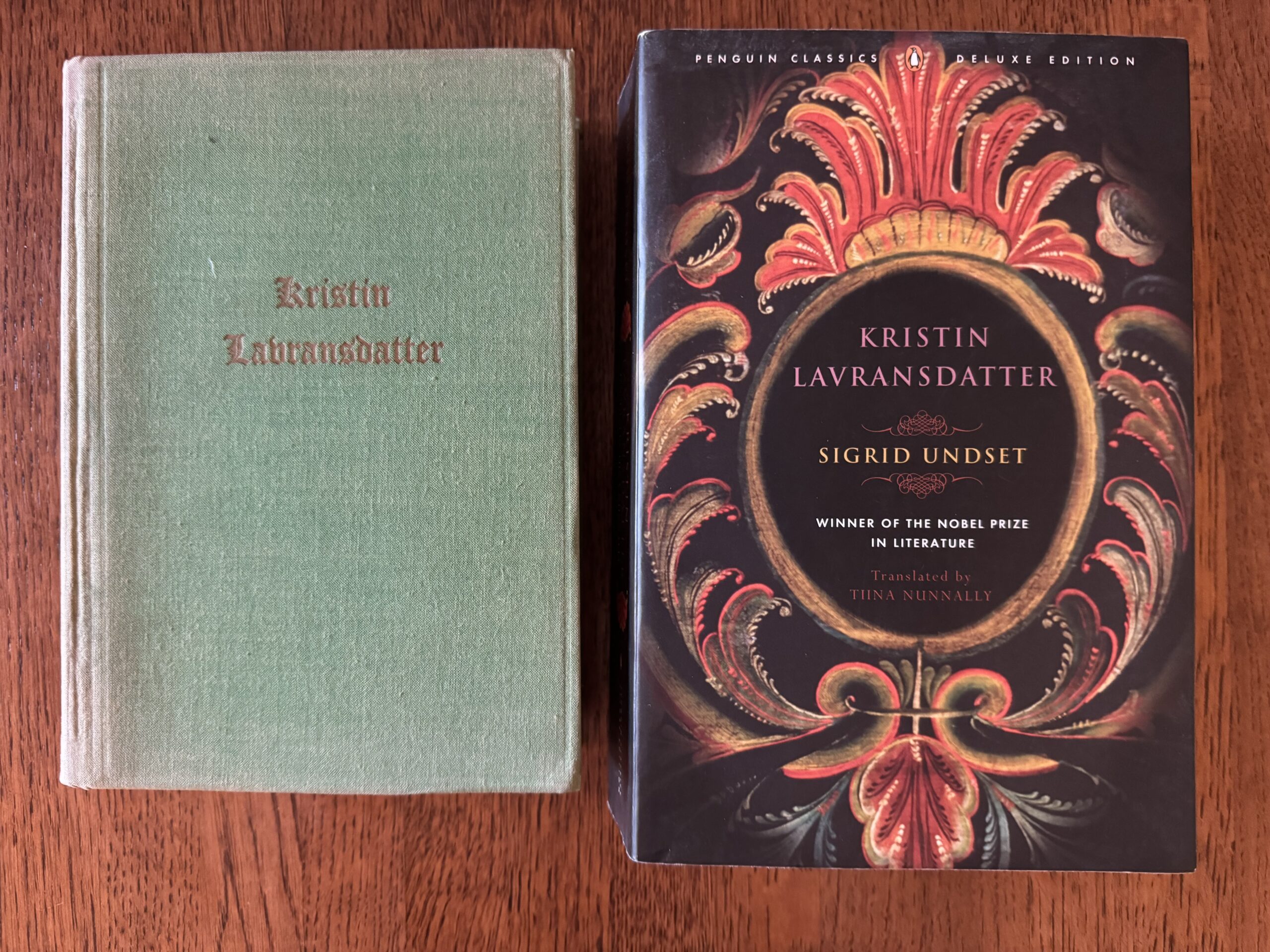
If you don’t know Kristin Lavransdatter, it is a three-volume novel by Nobel prize-winner Sigrid Undset, first published in the 1920s and never out of print, about the life of the passionate Kristin and her 14th century Norway, medieval and richly Catholic. I have the older version from when I first read Kristin, but Tiina Nunnally’s newer translation is luminous, and I’m glad to own both.

In the novel, Sister Cecilia, a nun in the convent where Kristin goes to stay for a time, one night at dinner begins to grovel before the other sisters and confess that she has done things out of arrogance, not out of love of God:
She had served her sisters with arrogance, she had drunk vanity from her water goblet, and she had spread her bare bread thick with conceit while the sisters drank ale and ate butter on their bread.
For punishment, the abbess proclaims that the sister must sit in her (the abbess’) chair for eight days, during which time the other sisters will show her respect
“that you will grow sated from the tribute of sinful people. Then you must judge whether this is worth so much struggle, and decide either to live by the rules as the rest of us do or to continue the trials that no one demands of you. Then you can contemplate whether all the things that you say you do now so that we might look up to you, henceforward you will do out of love of God and so that He might look upon you with mercy.”
After this punishment during which she “wept as if she were being beaten,” she has a new spirit:
“She continued to live in almost the same manner as before, but she would blush like a bride if anyone looked at her, whether she was sweeping the floor or walking alone to church.”
Now, even as I write, I am surprised to see how I am comparing or even judging a real person with this character. My friends and family, I hope, know me as someone who is definitely not a “judger.”
I’ve been known to say, “You don’t know that person’s story, even if they tell you.” (This I freely lift from the Chronicles of Narnia, where Aslan tells several characters this very thing). And it sounds so much like I am judging this blogger’s motives and spiritual life.
But as a literature lover and reader, I don’t think I’m the only one who finds myself comparing certain situations, especially when they are far removed from me, to characters in novels. And I couldn’t help thinking the blogger could benefit from being “punished” by an abbess.
So I’ve promoted myself to abbess and handed down this punishment: this unnamed blogger shall use the money she is saving by trying to live a simple life not to give to the poor or some other noble goal, but to lavish on her husband and herself for a time—expensive dinners out, fancy dinners at home, babysitting so they can go see the latest frivolous goofy movie, a spa treatment or two, even– and see if that doesn’t help the situation, both in her family and in her own heart.
As Catholics, we are so fortunate to have the liturgical seasons–times of fasting and times of feasting–to balance our human selves that might tend toward one extreme or another. It’s not always Lent, and it’s not always Eastertide. We can do more penance than the church prescribes, but primarily with the help of careful and wise spiritual direction.
There’s a famous story about St. Francis about a time when his disciples were arguing about whether it was proper to eat meat on Christmas Day—that year it fell on a Friday. And Francis, took the raw meat and dragged it along the walls, saying, “It’s Christmas Day; even the walls should eat meat!”
I’m not sure if this post qualifies as a “review” of Kristin Lavransdatter, except to say that the book is such a part of my life’s fabric that I fairly often find myself comparing a situation in the novel to one in real life. If you tackle this three-volume novel, I think you’ll find it well worth the effort, both for reading reasons and for its spiritual insights.
Interesting/Notable:
Oslo bishop to open Sigrid Undset canonization cause— The Pillar
‘She stood firm in the Catholic faith, challenged Nazism, and strove for Norwegian freedom’.