Category: Weekly Newsletter

  • The Credit Series, Part 2: Credit Reports (Mom’s Occasional Money Advice)

    The Credit Series, Part 2: Credit Reports (Mom’s Occasional Money Advice)

    The Mom Weekly Volume 56: September 3, 2024

    Notes: Yes, It’s annoying

    I want to confirm that yes, this credit score/credit report/keeping up with your finances can get tiring and downright annoying. But sometimes the annoying part can be getting over the initial steps. For this week: once you’ve retrieved your credit report and looked it over for mistakes (and corrected any!), it will be that much easier the next time.

    But it is worthwhile effort. “Future You” (next year you, next decade you, etc. …) will thank you for taking the time to understand this information, and keeping track of to clear up any suspicious information right away.

    Remember how much I love you,

    Mom

    The Credit Series, Part 2: Credit Reports (Mom’s Occasional Money Advice)

    If you followed along last week on credit scores, you may have noticed when you checked your own credit score, that the source (Discover, Chase, or some other source) offered “for further information” to go to annualcreditreport.com

    The home page for AnnualCreditReport.com,

    The website may look scammy or dated, but I promise, it is legitimate and the only way to obtain your full credit reports.

    Here is the Wikipedia article describing its genesis.

    The three credit bureaus announced in 2021 that they would provide free weekly credit reports to anyone who requests it, through 2022. Even though that deadline passed long ago, the website still offers free weekly credit reports. These free weekly reports may go away at some point, but in the meantime, it’s a good idea to set up a regular schedule to check your credit score using this perk.

    A couple of cautions:

    • Note the upsells:

    —when you go through this process, one or more of the bureaus will try to “upsell” you to sign up for one of their paid services. One feature they offer is your FICO score, but as you know from last week, you can get that for free from a credit card company (even if you don’t have a credit card with that company).

    • Consider credit monitoring on your own.

    —both credit card companies and credit bureaus offer “credit monitoring” or “identity theft protection” for a fee. The fees for this can range from $15 on up. While it can be good to monitor your online activity, you can do this through checking your credit report often and flagging any inaccurate information or suspicious activity. 

    The Wall Street Journal had an article about cybersecurity that I found really useful (this is a gift link).

     It actually suggests, (as I do! naturally), checking your. credit reports weekly to check for any changes or suspicious activity.

    When I retrieved my credit reports, I found that two of the three included an address where I’ve never lived. It actually was the address for a local Travelodge Hotel, and that address been added to my report in 2019. I’m not sure how I didn’t notice it in 2020 when I discovered my identity had been stolen (you can read the whole post about it her 

    Let’s go through some steps to retrieving your credit reports together:

    • when you click on “request free credit reports”, you will have to fill out quite a bit of information.

    name

    address

    social security number

    This is just the beginning of the information you have to fill out ….

    and more. If you’ve lived at your location for more than two years, you can enter only one address. Otherwise, you will enter your second last address.

    Once you do that, you may have to verify your identity. For instance, I had to provide my email and phone number, and then use my phone number for a 2FA. After that, I was offered several questions to answer. I’m not including my exact questions here, but as an example, it would say something like:

    You have an auto loan that originated in 2023. Choose what is closest to the monthly payment for this loan:

    — $300-$540

    —$600-$700

    —$1000-$1200

    —none of the above

    Or, another question could read:

    You have credit cards with a number of issuers, except for

    —Chase

    —Wells Fargo

    —Citi

    —Discover

    —none; I have cards with all of these issuers

    You’ll need to answer these questions accurately, but I’ve never had any trouble with getting them “right.” But someone who doesn’t know much about you would have a hard time answering them.

    Next, you’ll have access to one of the bureaus reports—either Experian, TransUnion, or Equifax. You may be given the choice to download each report, which is not a bad idea. (Don’t try to print them, as each will be many, many pages long!).

    Take a look through it for any prior addresses; if I had done this before, I would have noticed the sketchy motel-address for myself. You should also check for any mistakes, or any accounts that you are not aware of.

    If you find something that is incorrect, there is a “dispute” or “correct” button on the report. 

    For the extra address, I filled out a “dispute” button, and explained that I never lived at that address. The next time I checked my credit reports, the address was gone.

    You’ll see many pages of credit payment history. This shows how often you paid on time (hopefully always!), as well as average balances.

    Now that you’ve completed this, set a reminder on your favorite format (I use ToDoist) to check your credit report again in another interval of time. It will be much easier.

    If you’re not actively applying for credit cards or another loan such as a mortgage or a car loan, you may want to freeze your credit. We’ll cover that another time!

    Interesting/Notable:

    It’s not about the nail

    I remember this when it first came out, and it’s even funnier now.

    “Button dogs” do understand words, and not just from their humans.

    Worth the read!  

    An Action Item: Request your credit report and flag any errors

    Yes, if you didn’t do so on our walk-through, do so  from all three credit bureaus, and take a look through it. Let me stress again that just a few years ago, you could only get a free credit report from each credit bureau once a year, so prior financial advice was to set a calendar reminder and request one from each bureau every four months.

    It really is so much easier, and I think worthwhile to take a look at your credit report at a regular clip. And also, don’t do what I did, and not look at everything carefully so that you can catch any incorrect information.

    What are you doing this weekend?

    So, now that it’s Tuesday, what are you planning for the weekend? I’m going to suggest trying to cover four “F”s to get ideas flowing:

    *faith—when are you going to Mass?

    *friends—what friends will you see or connect with?

    *food—any fun recipes you plan to try, or restaurants you plan to visit?

    *fun—anything interesting you are going to play, watch, or do this weekend? Now’s the time to think it through, and put it on the calendar (even informally).
  • The Credit Series Part 1: Your Credit Score (Mom’s Occasional Money Advice)

    The Credit Series Part 1: Your Credit Score (Mom’s Occasional Money Advice)

    The Mom Weekly Volume 55: August 27, 2024

    Well, buckle up, kiddos, because this is a long post of Mom’s Occasional Money Advice. I am going to break this into several parts, since writing about credit score alone is so long.

    The genesis for this is a lengthy text exchange I had with one of your cousins earlier this year about credit scores. I love getting to answer questions about these things, even if I have to do some research. I “heart emoji” answering money questions. 🙂

    Remember how much I love you,

    Mom

    The Credit Series Part 1: Your Credit Score (Mom’s Occasional Money Advice)

    I won’t go into the whole history behind credit scores. If you are interested in exploring, here’s a good introductory article on how credit scores came to be.

    Our goal for today? A quick look at your credit score. I’ll show you how to find yours, what each element means, and ways you can bring it, if you want. This is not a bad idea for anyone, even if your credit score is great.

    Your Credit Score

    Let’s start by obtaining your “credit score.” There are actually many variations/flavors of this, and places to obtain them, but let’s do the easiest: check with one of your credit card issuers.

    I find Discover’s information to be highly accurate and useful.

    If you have a credit card with Discover, there is a link on your home page to view your FICO score (image). If you do not, you can get one for free by visiting here.

    Chase, another credit card issuer, offers something called “Credit Journey” which also shows a FICO score and more info.

    If you don’t have a Chase credit card or other account, here is the free link to gather your information:

    For the purpose of this Weekly, I opened a Credit Karma account, but I found the data not as accurate as Discover or Chase. I’m not sure why, but it shows me as having only 9 years of credit history, as if I were an actual baby.

    But I digress.

    Here is a screenshot of a recent credit score.

    This is mine, but with much of the information cut off for security purposes). My credit score is 822 — exceptional, according to Discover—thank you Discover! We will be going through each of the “tabs” listed in that photo, to show what goes into your credit score.

    What Goes into Your Credit Score:

    Column 1: FICO score.

    This number will be different from different sources. Here you can see it is 822. Chase tells me my FICO score is 807. (Darn you, Chase! For some reason, Chase’s number is almost always slightly lower than Discover’s number).

    Scores above 700 usually are sufficient for the best rates on a mortgage, car loan, and credit card approval. Keeping it well above that, once you get there, should be a goal.

    How to improve your score? Let’s check each element.

    Column 2: Number of accounts—10 percent of credit score

    The second column is the number of accounts, which contributes about 10 percent to your credit score. But unless you have no credit at all, this doesn’t matter (except as it relates to credit utilization, which we will get to below). This can include your credit cards, a mortgage, and car loans. It’s unclear to me whether it includes student loans, since I don’t have them.

    I happen to have a fair number of credit cards because of travel rewards, but it has no bearing on my credit score.

    While my score does go down slightly when I open a new card, it bounces back and usually higher with a month or so. So, if you are in the market for a mortgage or car loan, you may want to avoid opening any new credit cards. But ahead of time–say a year or two– it could actually make sense to open a few credit cards. Let’s cover that in when we get to “revolving utilization.”

    Column 3: Length of Credit—15 percent of credit score

    This shows the amount of time that you have a credit history. Mine is over 30 years long. This is the reason I would never close my oldest credit cards.

    Length of credit accounts for 15 percent of FICO score. So, for instance, we opened the kids’ credit card years ago so that you could have a longer credit history than you could by opening a card once you turned 18. And fortunately, it did help your credit scores by giving you a longer “length of credit” than other people your age.

    How to improve length of credit: Apart from the passage of time, it’s important to note that you should never close your oldest credit cards. If you are concerned because an older card has an annual fee, you can usually downgrade to a no annual fee card.

    Column 4 “Inquries”—10 percent of credit score 

    More inquiries, or credit checks, will reduce your score, and this number affects about 10 percent of your credit score. This is why you shouldn’t apply for 10 credit cards all at once.

    What to look for: if this number is higher than you expect—say, you only applied for one credit card in the last year, and this number is 5 or something higher, it’s worth looking into by pulling your credit report. We will get to credit reports next time.

    The number here means the number of “hard inquiries” on your credit. So, if you applied for a car loan, mortgage, or credit card, you would have given permission to have them check your credit. That’s a “hard inquiry” or “hard pull.” (This is different from a “soft inquiry,” which is when advertisers target you for credit card or other credit offers. That has no effect on your credit score).

    How to improve: this is not a very big part of your credit score. Unless you are applying for a lot of credit at one time, this won’t have a big effect on your credit score.

    Column 5: Credit Usage—30 percent of your credit score

    Now we arrive at categories that have a much bigger impact on your score.

    Revolving utilization, or credit usage, is one of the key elements in your credit score—accounting for about 30 percent of your score. Understanding this and paying attention to this can really pay off (pun intended!) in a higher score.

    It’s also called “utilization” or “credit usage.” Credit usage is a simple math problem: your card balances (what you have charged and not yet paid off) divided by the amount of total credit (what you could spend) on your credit cards equals your credit utilization percentage. 

    Chase and Discover say that less than 30 percent utilization is ideal, but you should strive to get this number as low as possible. As an example, my credit usage (credit utilization) is usually right around 3 percent.

    What that means is that I am using 3 percent of what I “could” be charging on my credit cards. The current balances on all of my credit cards at this moment total only 3 percent of what their limit is. 

    Let’s use, for an example: a person who has only two credit cards: a Discover and a Citi card. 

    The credit limits are:

    $3,000 on the Discover credit card.

    $7,000 credit limit on the Citi credit card.

    That means her utilization or credit limit would be $10,000 ($3,000 plus $7,000). 

    If there were $100 charged on the Discover since it was last paid, and $900 on the Citi credit card since last paid, the total utilization (or credit usage; what the person is actually using) would be $1,000 out of the $10,000, or 10 percent ($1,000/$10,000). Still very respectable numbers, but even lower is better.

    How to improve this: one way to increase your credit utilization total, and, by default (assuming you spend the same no matter how many credit cards you have), is by responsibly opening a credit card. That will increase the credit usage or utilization total.

    Using the example above, if our person with the two credit cards applies for and is approved for a Chase card with a limit of $10,000, her total utilization is now $20,000 ($3k Discover plus $7K Citi plus $10K Chase).

    So, assuming the amount charged on all of the cards is still $1,000, the credit usage is halved. Her credit usage is now 5 percent ($1,000 divided by $20,000, or .05), instead of 10 percent, as before.

    Even if you don’t use a card, the credit limit on that card gets added to your other ones, and increases your total credit limit, and therefore lowering your utilization limit. That’s why I recommend, for people who are responsible with credit cards, to consider opening new cards from time to time.

    At the very minimum, don’t ask your credit limit to be reduced when it is raised. If you have a good record of paying your bills on time, the amount you can charge will increase by a little or a lot by the credit card issuer, over time. As long as you’re not spending “to the limit,” this is a good thing.

    Missed Payments: 35 percent of your credit cards

    Obviously, paying bills on time is a high priority, and it has a big impact on your credit score. If you miss paying a credit card (even the minimum payment), your score will take a hit. Having a system for paying your credit card bills is a good idea.

    A “missed payment” does not include only paying the minimum amount due on your card. If you owe $2,000, but your minimum payment is $40, and you pay $40, you are fine in this category.

    Even if you carry a balance (and a large balance, unfortunately), you will not be “dinged” for your credit score. But here, once again, is Mom’s advice that has little to do with your credit score, but is arguably a much bigger goal/personal finance practice: pay your credit card bills in full.

    The gold rule of credit cards: pay them off in full and on time, every month.

    I know you know this, but it cannot be said enough. There is no reason to “leave” the charges there for any reason, and incur all the interest (in the 20 percent range! Or higher! It’s highway robbery!) that credit cards charge.

    There’s a relatively uncommon—but shockingly seen a fair bit—misconception I’ve seen in the personal finance space that you should keep a “balance” on one or more of your credit cards to “improve your score.” But that is complete and utter nonsense. 

    How to avoid either getting a “missed payment” ding to your credit score, or a huge interest bill for only partially paying a card? Have a system for paying your bills.

    I don’t even wait until my credit cards are due—I just pay them the day I get the notice of the bill. That’s just the way I run things, but you can do it other ways. 

    For instance, some people use auto-pay the total for each credit card they have. That can be smart, and assuming you have enough in your account, it guarantees you will never have a missed payment. I don’t happen to do this because I want to be able to look over the charges, make sure I have enough in to cover the bills in the account I pay from.

    Also, the default for auto-pay is I think on the due date, which I don’t love because I just want to see it’s paid well ahead of the due date. I guess if you’re going to use autopay, or if you do, I would recommend setting the “pay” date to a week or so before the due date so there’s no mixup.

    Next time: Credit Reports! Let me know if you have any questions on credit scores.

    Interesting/Notable:

    A Gentler, Better Way to Change Minds

    Sheet Pan Pancakes with Mixed Berries

    This looks interesting but I wonder if it would turn out as good as it looks? This is the original recipe on which it is based.

    An Action Item: Check Your Credit Score

    As detailed above, it is very easy these days to get a full picture of what your credit score is, and see if you have any areas that can be improved. At minimum, you could note your credit score, and check it again in a month. It truly takes very little time, and you can follow along with the details above to see where you can improve or at least stay steady.

    What are you doing this weekend?

    So, now that it’s Tuesday, what are you planning for the weekend? It’s Labor Day weekend, so remember to plan for something that extra day!

    I’m going to suggest trying to cover four “F”s to get ideas flowing:

    *faith—when are you going to Mass?

    *friends—what friends will you see or connect with?

    *food—any fun recipes you plan to try, or restaurants you plan to visit?

    *fun—anything interesting you are going to play, watch, or do this weekend? Now’s the time to think it through, and put it on the calendar (even informally).

  • Trinity Bars (The Second Annual Grandpa Joe’s Birthday Treat Recipe)

    Trinity Bars (The Second Annual Grandpa Joe’s Birthday Treat Recipe)

    The Mom Weekly Volume 54: August 20, 2024

    The Second Annual Grandpa Joe’s Birthday Treat Recipe

    Last year, right around this time, I posted a recipe of Tunnel of Fudge Cake in honor of what would have been Grandpa Joe’s 96th birthday, and his famous sweet tooth. Many of us have inherited that sweet tooth!

    I will make it an annual tradition to share a decadent sweets recipe around Grandpa Joe’s birthday in August. And also to make the dessert! This year, it will be Trinity Bars.

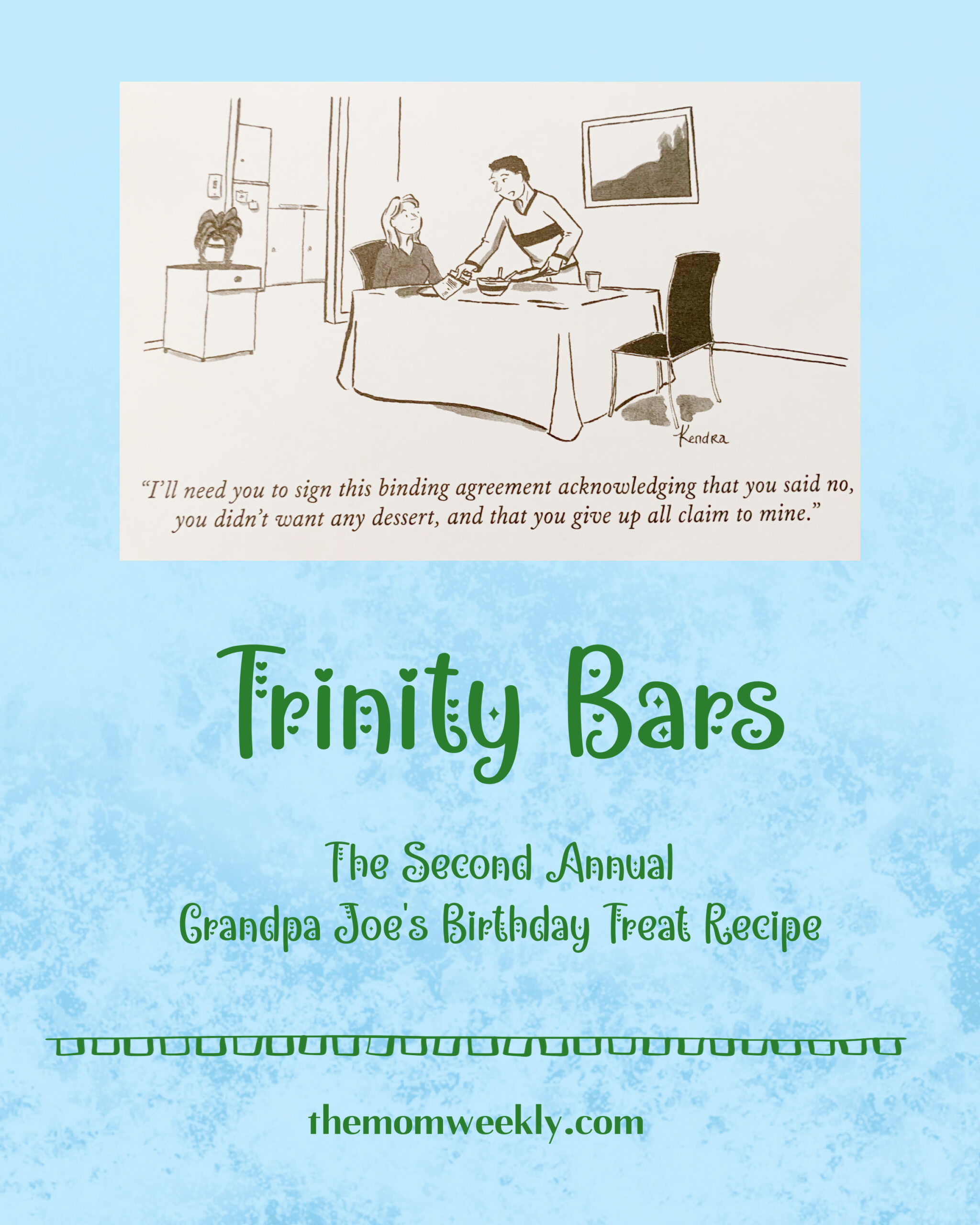
    I couldn’t find a photo of Trinity Bars, so I put these (to me) funny New Yorker cartoon from a page-a-day calendar)

    Remember how much I love you,

    Mom

    Trinity Bars

    I think this recipe has other names, but I’ve adjusted the recipe enough that I get to name them, and since there are three layers, I dubbed them “Trinity Bars.” Perhaps Trinity Bars could be a good teaching moment about the Trinity, much like St. Patrick did with shamrocks. But I’ll leave that to the theologians in the family. 🙂

    Trinity Bars are a three-layer treat: a bottom brownie layer; a middle buttercream frosting layer; and a “goody” peanut butter/chocolate/rice krispie layer.

    For the bottom brownie layer:

    Preheat the oven to 350 degrees.

    Spray a 9×13 pan with Baker’s Joy or similar non-stick spray.

    Prepare a box of Duncan Hines Dark Chocolate Brownie Mix with these additions instead of the listed one: 

    1/2 cup melted butter

    1 egg 

    1 T vanilla, 

    a sprinkle of salt

    Spread in the prepared 9×13 pan and bake for about 20-25 minutes, until a toothpick inserted in the center is clean or contains only crumbs.

    Allow brownies to cool completely before spreading on buttercream frosting layer.

    For the middle buttercream frosting layer:

    beat together

    1/2 cup butter, softened

    3 to 4 cups of powdered sugar

    1 teaspoon-plus vanilla

     teaspoons of half & half as needed to achieve good consistency.

    I alternate between one cup of powdered sugar, a couple of tablespoons of half & half, and so on.

    spread frosting on top of baked and cooled brownies

    Important note: No, you can’t use a canned frosting. It doesn’t take very long to make homemade frosting, and it is well worth it.

    For the krispie “goody” layer:

    Measure out about 3 cups of Rice Krispie cereal (store brand is fine) into a large bowl.

    In a big microwave safe glass bowl (I have a 4-cup pyrex that works well for this), melt:

    1 cup creamy peanut butter

    2 cups chocolate chips

    Cook for about 1 minute in the microwave, then stir. If it’s not smooth, continue with 30 second intervals (stirring in between), until it is.

    Mix in 1 teaspoon or so of vanilla.

    Pour over the Rice Krispies in the large bowl and mix until combined.

    Carefully spread this topping on the frosted brownies.

    Chill before serving, then cut into small squares. Yummy! 

    Interesting/Notable:

    Macroculture versus Microculture

    I keep a list of interesting/notable things to share here, and revisted this one from December. It’s quite interesting, but I’m not sure how much I agree with it.

    An Action Item: Consider Meal Planning or Prepping for the Week Ahead

    As I’ve said before, I often put these action items in based on things that I would like to do, or do better.

    I have tried, with varying levels of success, to meal plan ahead. We’ve gotten into a good routine of pizza in the Ooni on Wednesday night, salmon on Friday night, and going out for something fun on Saturday night after Mass. So there aren’t so many days to figure out what to have. Even with that, I find it helpful to look ahead about a week and a half ahead to see if there are any conflicts or days we will be away. So when I go to Aldi, I can stock up on what things I might need.

    So, for example, let’s take a week of dinners from July:

    Sunday: pasta with red sauce and breaded eggplant & zucchini

    Monday: book group over; chicken salad, croissants, various salads (potluck)

    Tuesday: cheese quesadillas with Southwest corn, raw veggies

    Wednesday: pizza in the Oonie

    Thursday: Culver’s (can’t remember why, but I’m sure it was fun!)

    Friday: salmon, pierogi, carrots and other cooked veggies

    Saturday: eat out at local Asian restaurant

    It could be a good start to look back at what you had for dinners in the last few weeks, and consider a rhythm of dinners that you like and that you find easy to make.

    What are you doing this weekend?

    So, now that it’s Tuesday, what are you planning for the weekend? I’m going to suggest trying to cover four “F”s to get ideas flowing:

    *faith—when are you going to Mass?

    *friends—what friends will you see or connect with?

    *food—any fun recipes you plan to try, or restaurants you plan to visit?

    *fun—anything interesting you are going to play, watch, or do this weekend? Now’s the time to think it through, and put it on the calendar (even informally).
  • The Epic of Gilgamesh (From the Vault, May 2007)

    The Epic of Gilgamesh (From the Vault, May 2007)

    The Mom Weekly Volume 53: August 13, 2024

    Note:

    I love “From the Vault” so much. I wonder if you kids remember any of these happenings. I don’t think I would if I hadn’t written them down at the time!

    Remember how much I love you,

    Mom

    From the Vault: The Epic of Gilgamesh (May 2007)

    A month or so ago, we had a taste of The Epic of Gilgamesh in our history book, The Story of the World, by Susan Wise Bauer. This is an excellent series and I’m so glad we can use it as the “spine” of our study of history.

    The accompanying activity guide has not just lots of fun hands-on activities and worksheets, many of which we do in our once-a-month co-op, but also lists for each chapter of well-selected extra literature selections.

    Many are picture books, but they are so well-done all ages would enjoy them. I usually send a huge email about once a month to Glenda, our terrific interlibrary loan lady, an email filled with these books for about 3-4 chapters at at time, and we have a great time going through them when they come in from the library. Usually Homegirl runs off with six or seven of them, and I will read one or two to the others. Then we have lots of interesting reads for the upcoming days.

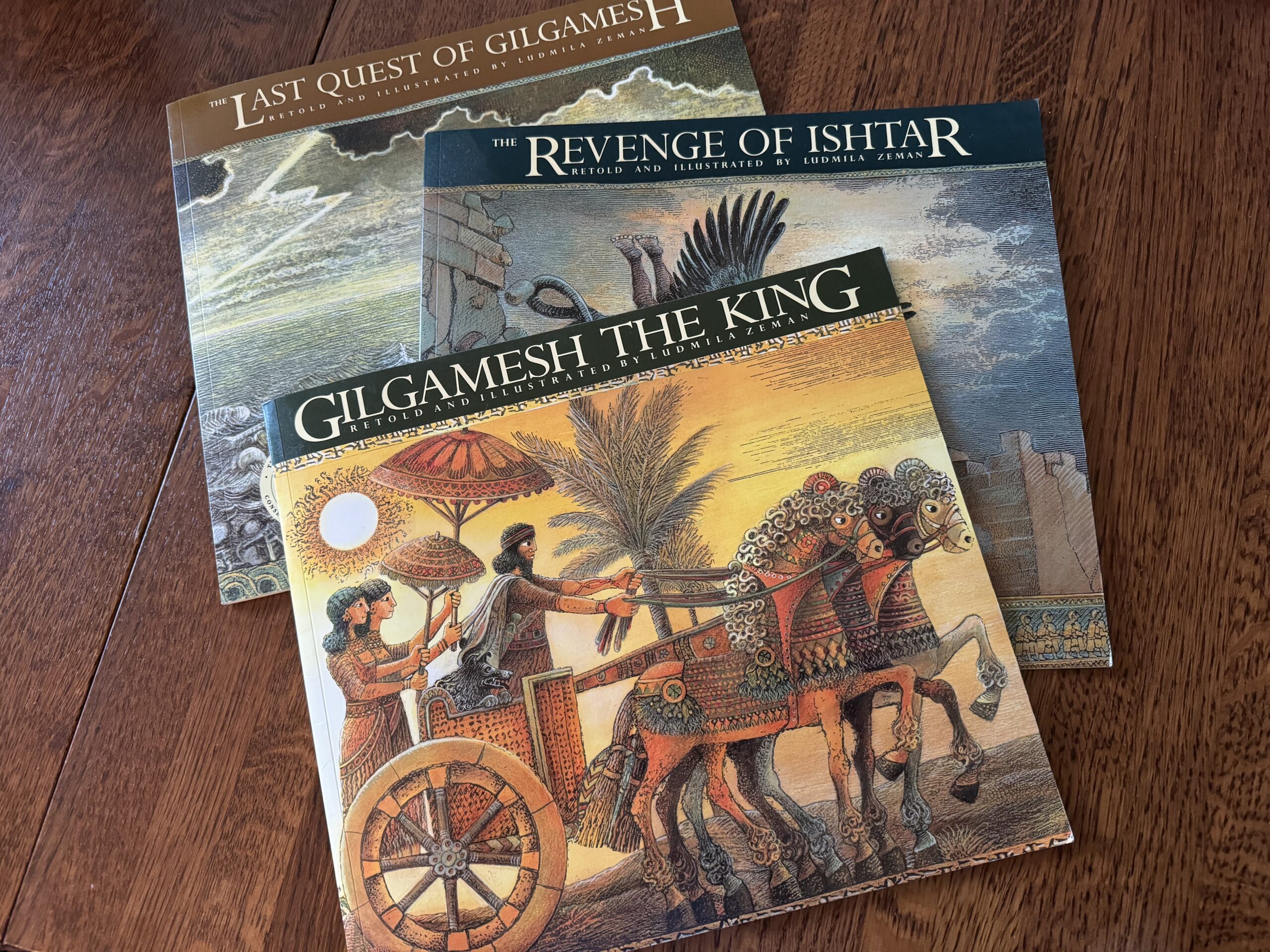
    One particularly compelling trilogy of books we are reading (from interlibrary loan, though I might decide to invest in them) is by Ludmila Zeman. The first is Gilgamesh the King, the second; The Revenge of Ishtar, and the third The Last Quest of Gilgamesh.

    Update: I did purchase the books, and I still have them!

    Her illustrations are compelling; fierce and beautiful at the same time. She also wrote the words and her way with words is wonderful.

    The Epic of Gilgamesh dates from about 2700 B.C., thousands of years before Christ. It tells the story of the Gilgamesh, a wicked but powerful king who learns about friendship and self-giving love by meeting his match in the equally strong but kind Enkidu. The themes of love, death, immortality and other “kid-friendly” themes (ha!) are part of all these books, and the children and I just loved them, and loved discussing them.

    Now, I am the kind of reader who reads straight. I tend not to ask kids questions while I read. I will pause at certain times, explain occasionally, but really want to read the story itself. I always answer questions, but I tend to be pretty no-nonsense in my reading style. Sir could not be more different–I will suggest a short, short book to read to children late at night when I just want a quick read and off to sleep, and he will draw it out for hours (ok., I’m exaggerating). But I do kind of admire how much he can draw out of the simplest text.

    This trilogy made it very easy for me to pause and discuss. The illustrations are so detailed we had to stop for awhile at each page. Every page brought up “big questions”. The last page in The Revenge of Ishtar reads,

    “As Enkidu and Shamat flew into the night,

    King Gilgamesh went out alone onto the river.

    ‘Death is the worst monster in the world,’

    he thought. It has taken Enkidu from me.

    Someday it will take me from my people.

    I must find a way to destroy it.

    I must seek out the secret of immortality.’

    ‘That will be my last quest.’ “

    On this page, little 3-year-old Max began spontaneously a discussion about how Jesus killed death (his major theme at the moment), and the girls had to point out that Gilgamesh lived (or was written, as I told them, because it is a story and not history) thousands of years before Jesus. So we talked about how all people throughout time have talked about and wondered about all these things–life, death, love, and what to think about them. We talked about how grateful we are to have the fullness of faith and truth Jesus brings us, but people have always sought answers to these questions and sought the good and the meaning of everything. I wish I could have had a tape recorder going because I was floored by how insightful these three children, all under 10, could discuss these “big things.”

    I don’t think it was necessarily how smart they are (though of course they are all above average :-)), but just a good book inspiring great discussion.

    I feel so grateful to be learning alongside my children with so many great resources. Thank you, Ludmila Zeman!

    Interesting/Notable: 

    Look at all those people taking care of themselves:

    Wow, this episode about a bishop taking a leave of absence for his mental health is so moving. .. all about relationality.

    I made a costly decluttering mistake—The Minimal Mom (Youtube)

    The tl:dr: Don’t be too annoyed when you get rid of something and you wish you had kept it. You can’t have both a peaceful, moderately uncluttered house, and also keep absolutely everthing. Not deciding to get rid of things is deciding, and can lead to problems!

    The Well-Off People Who Can’t Spend Money–The Atlantic (gift link)

    An action item: Check your Roth IRA

    We haven’t had a Roth IRA item in awhile. So let’s take a moment to do two things related to Roths. As written previously , it’s easy to open and maintain a Roth IRA. The only requirements for contributing to a Roth IRA are: one: having a Roth IRA account two: earned income and three: not too much earned income (as the ability to contribute to a Roth phases out at higher income levels. There are even ways to get around that, but let’s stick with the simple for now).

    Read this article to get the basics.

    Two Roth-related things to do:

    One: check that you are funding your Roth this year.

    How much have you contributed this year so far? If you have an auto-deposit set up for this, would you like to bump it up by some amount ($10, $100, etc.) monthly before the end of the year? Recall that the 2024 limits for Roth contributions is $7,000 for people under 50 ($8,000 for those 50 and up).

    Two: Make sure you are investing the funds in your Roth IRA.

    It might be in cash or a cash equivilant. Don’t worry, we’ve all done this. That’s better than not having a Roth, but the beauty of Roth earnings is they are never taxed. So the sooner you can get it into a low-cost index fund or ETF, the better.

    Some ideas for low-cost ETFs/index funds that passively index the entire stock market—these all have basically the same returns:

    VTI: Vanguard Total Stock Market 

    SCHB: Schwab’s version total stock market ETF

    FSKAX: Fidelity’s Total Stock Market Fund

    If you need any help with any of this, or have any Roth-related questions, just let me know. I love answering these kinds of questions!

    What are you doing this weekend?

    So, now that it’s Tuesday, what are you planning for the weekend? I’m going to suggest trying to cover four “F”s to get ideas flowing:

    *faith—when are you going to Mass?

    *friends—what friends will you see or connect with?

    *food—any fun recipes you plan to try, or restaurants you plan to visit?

    *fun—anything interesting you are going to play, watch, or do this weekend? Now’s the time to think it through, and put it on the calendar (even informally).

  • Happy One Year Anniversary!

    Happy One Year Anniversary!

    The Mom Weekly Volume 52: August 6, 2024

    On July 25, 2023, The Mom Weekly began.

    Thank you for reading along for an entire year! 

    I am interested and proud that my goals have stayed ths same from Volume 1, as has my sense of urgency to share ideas and concepts. And I don’t have any plans to stop, so you’re stuck with me. 🙂

    What has delighted me is when family members and the occasional friend will send me a quick text or email to say how much they enjoyed that week’s offering. I even like it someone disagrees with something I have written. Apparently, I love dialogue! Who knew? LOL.

    And I especially love questions and suggestions. More than a few times, a question from someone has led to a weekly reflection. That process helps to organize my thoughts (and even change them). By writing about something, I understand it better.

    For no discernable reason (I didn’t even remember why at the time!), I missed one week late last fall, so the anniversary each year for me will be around the beginning of August. Even more oddly funny: as I looked through to see which week I missed, I noticed that not once, but twice, I numbered a weekly the same one as the week before (Volume 34 and Volume 48, in case you’re wondering, which I’m sure you are not). 

    So this weekly should perhaps be numbered 53, or 54? Who knows? I am not going back to change all of that (everyone makes mistakes, after all). We will just go forward and I will try to celebrate around the first week of August.

    What am I going to do to celebrate? Probably bake something chocolate. I hope you will celebrate too, and remember that you can always respond to a weekly by replying to the emails, or texting, me or reaching out in any other way. I love hearing from you.

    And, as always: remember how much I love you,

    Mom

    Interesting/Notable: 

    Fertility Awareness — good article!

    Roz Chast on a great term from the Great British Baking Show.

    An Action Item: (Continue to Educate Yourself About Scam Stories)

    It is well worth reading this entire article about yet another person scammed out of almost their whole life savings.

    How One Man Lost $740,000 to Scammers Targeting His Retirement Savings (gift article)

    A couple of takeaways: 

    *scammers isolate people from their loved ones and create a sense of urgency

    *anyone can get scammed (this person is a retired lawyer)

    *family and friends are good for helping us keep out of harm’s way, but can also be a good source of solace when we have been through something. Keeping silent about it is understandable, but sharing these kinds of stories.

    *I think it’s really important to be open with family members or trusted people in our lives. Remember when the personal finance writer who was scammed out of $50,000 in one day? Here’s what one of the criminals who supposedly worked the IRS, told her: 

    Calvin told me to listen carefully. “The first thing you must do is not tell anyone what is going on. Everyone around you is a suspect.”

    Anyway, this is just my regular reminder to be aware of things around you, and remember that we are better for living in community, and we should act like it!

    I hate to even share this other link, because it is so depressing.

    The Slave Sending You Scam Texts

    This is a podcast episode from the Wall Street Journal about the criminal enterprises in Southeast Asia who are trafficking people into slavery to scam others. And I alwys said that there is a special place in purgatory (or hell, let’s just say it, hell) for people who defraud others. And the criminals who trick individuals into slavery in order to scam people of their money? Well, a different, and much worse, place in purgatory/hell, for them.

    What are you doing this weekend?

    So, now that it’s Tuesday, what are you planning for the weekend? I’m going to suggest trying to cover four “F”s to get ideas flowing:

    *faith—when are you going to Mass?

    *friends—what friends will you see or connect with?

    *food—any fun recipes you plan to try, or restaurants you plan to visit?

    *fun—anything interesting you are going to play, watch, or do this weekend? Now’s the time to think it through, and put it on the calendar (even informally).
  • I am a Rock

    I am a Rock

    The Mom Weekly Volume 51: July 30, 2024

    Notes

    Not that anyone is wondering about my process of creating The Mom Weekly, but here we go anyway:

    I have a TMW document, and whenever I have a concept to share, or an idea that pops up to me that might make a good headline and good discussion topic, I start it as a section. This has its own headline, and either right then, or in a future writing block, I will spend some time developingit. Just a few of the many, that may or may not make it into a future weekly:

    Trinity Bars

    Saint Francis de Sales always cracks me up

    Gaslight/Red Light

    The Household Book

    My many and sundry readers are surely on the edge of their proverbial seats just waiting for these, haha. (Hand on heart, the Saint Francis de Sales one is hilarious, but right now only to me. I need to work on it to make you understand how funny it is!!!)

    There is also a group of “From the Vault” posts “mostly” ready to go.

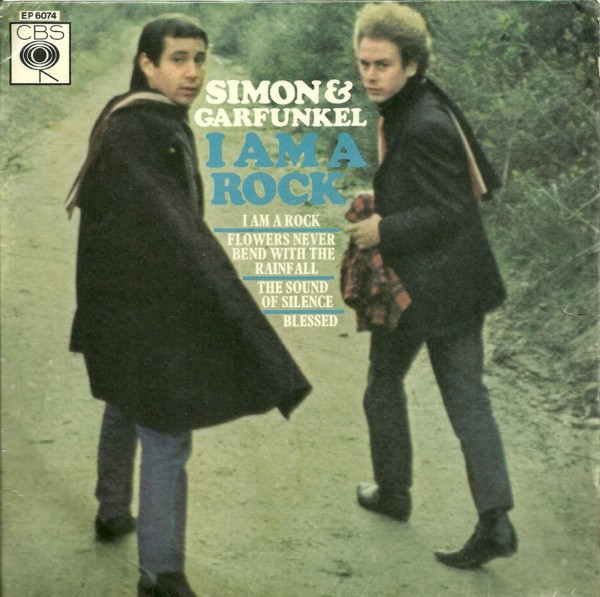
    Some time ago I wrote about this Simon & Garfunkel song. And the other day, when the song played somewhere (a store? the radio? no memory), I thought: Time to finish this one!

    I am a Rock

    Recently, a high school memory popped up, unbidden but fully formed.

    One of my high school religion teachers was trying to explain how self-sufficiency is a dangerous myth.

    (Bless their hearts, the religion teachers during my high school days really tried, but it was quite the Wild West of “anything goes” in religion class during that time period. I learned little about the Catholic faith, and there were some really weird vibes from time to time. But I think most of them [not all! but we won’t cover that today] were making an effort to do good. )

    In one class, this teacher played the Simon & Garfunkel song, I am a Rock.

    The teacher told us that when he was a teen and first heard the song, he took it literally. He thought that he was supposed to be a rock, and not feel any pain, and not rely on anyone else, ever. But, as he told us, he was wrong, and as he matured, he learned to connect with other people.

    So whenever I hear I am a Rock I think about how what it really means. 

    Here are the lyrics:

    A winter’s day

    In a deep and dark December

    I am alone

    Gazing from my window to the streets below

    On a freshly fallen silent shroud of snow

    I am a rock I am an island

    I’ve built walls

    A fortress deep and mighty

    That none may penetrate

    I have no need of friendship, friendship causes pain

    It’s laughter and it’s loving I disdain

    I am a rock I am an island

    Don’t talk of love

    Well I’ve heard the word before

    It’s sleeping in my memory

    I won’t disturb the slumber of feelings that have died

    If I never loved I never would have cried

    I am a rock I am an island

    I have my books

    And my poetry to protect me

    I am shielded in my armor

    Hiding in my room safe within my womb

    I touch no one and no one touches me

    I am a rock I am an island

    And a rock feels no pain

    And an island never cries

    Related to this, I read a surprisingly vulnerable newsletter from entrepreneur Pat Flynn.

    In this, Flynn tells a story about a request when he was seven years old going wrong, and how it affected the way he lived in the world for a lot of his young life:

    I began to feel that it wasn’t worth the risk of disappointment to ask for things anymore. This is why I grew up very independent and likely to just figure things out on my own.

    I also felt like I was a potential burden to others, not wanting to make people feel bad if they didn’t have the time or didn’t know how to help.

    As I write this out, it actually explains a lot about how I grew up and why, when I became an entrepreneur in 2008, I was so conditioned to believe that asking for help was bad that I refused to do it.

    But here’s the twist: as entrepreneurs, the ability to ask for help is not just beneficial — it’s essential. The belief that we must do everything on our own can be our biggest obstacle. We fear being seen as weak or incompetent, but in reality, asking for help shows strength and wisdom.

    Over the years, I discovered something surprising and wonderful: people actually want to help. When you allow them to lend a hand, they often feel great about it too. It creates a sense of connection and mutual support that benefits everyone involved.

    If you read Flynn’s story, you may resonate with his childhood experience. I think most of us—myself included!!!—can remember as a kid asking for something, and it going wrong some way, and feeling helpless about it and resolving to not ask for help in the future. 

    Those feelings may not last–and they are much less common the older you get— but I can understand where they come from. I am a rock. I am an island. And a rock feels no pain. And an island never cries.

    Knowing that this is a common impulse and emotion, how can we guard against it?

    Here a few ideas I am telling myself:

    • having regular intentional connection with others
    • being vulnerable with trusted family members and friends, sharing my struggles 
    • asking for help—people really want to help! I want to write an entire newsletter about this very thing! (note to self: title—“People Want to Help”)

    I am a rock. I am an island.

    In my memory, the teacher in no way tied his reflection on I Am a Rock to our Catholic faith. But the message really is compatible with the sense of communty and family life being more important than “going it alone” or radical individualism. 

    Here’s a relevant paragraph I found in the Catechism of the Catholic Church:

    CCC 2250 “The well-being of the individual person and of both human and Christian society is closely bound up with the healthy state of conjugal and family life” (GS 47 § 1).

    The Catechism was created years after my high school class, but this paragraph is actually a quote from Gaudium et Spes (“Joy and Hope”), one of the four documents of the Second Vatican Council from the 1960s. None of these concepts are new, in life or in our faith. 

    What is the biggest take-away from this?

    We are not meant to go it alone. We are not all “rocks” but something much more organic and interconnected. As Jesus says in Scripture:

    “I am the vine, you are the branches. Those who abide in me and I in them bear much fruit.” (John 15:5)

    Remember how much I love you,

    Mom

    Interesting/Notable:

    Olive Garden bread

    Someone shared this earlier this summer, and I wondered if it was as good as remembered. It is!!!!

     It’s a minute or more, but 100 percent worth the watch.

    An Action Item: Make Plans to See a Friend in the Next Week

    Many times these “action items” exist because either I have just done something, or I want to be reminded about doing something. This one is a perennial issue for me—wanting to see friends, but overcoming the inertia of making the plans is hard to overcome! It’s not as if it’s a harrowing experience to text or call someone and say, “let’s get together!” But all too often, I find myself putting it off.

    This week, I do have plans to meet a friend for Mass and to check out a rural store she’s visited I’ve never been to. When I see this, it will be my reminder to make plans to see someone next week. I encourage you to do the same!

    What are you doing this weekend?

    So, now that it’s Tuesday, what are you planning for the weekend? I’m going to suggest trying to cover four “F”s to get ideas flowing:

    *faith—when are you going to Mass?

    *friends—what friends will you see or connect with?

    *food—any fun recipes you plan to try, or restaurants you plan to visit?

    *fun—anything interesting you are going to play, watch, or do this weekend? Now’s the time to think it through, and put it on the calendar (even informally).